REFINEMENTS IN KEY DEVELOPMENT
PARAMETERS FOR DUXTON PLAIN HOUSING
DEVELOPMNENT
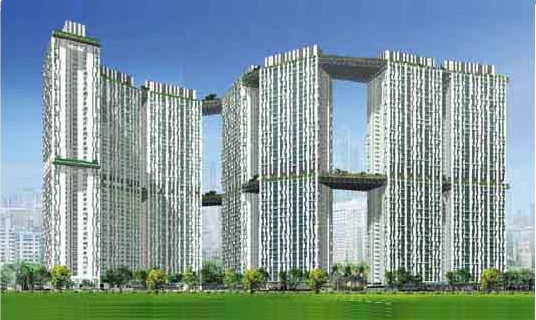
Refined Design details (Original
Design Proposal in brackets)
Number of storey: 50 (48)
Number of dwelling unit: 1,848
(1,890)
Type S1: 1,232 (1,260)
Type S2: 616 (630)
Flat size
Type S1: 90.0 to 94.0 m2 (92.9 to
98.0 m2)
Type S2: 101.7 to 105.1 m2 (100.1 to
104.1 m2)
Facilities
- 1 single-storey food court (A few
kiosks/cafes)
- 4 Shops and 1 convenience store (1
convenience store)
- 1 childcare and education centre
(1 childcare centre)
- 1 Resident Committee Centre (1
Resident Committee Centre)
|
Pinnacle@Duxton holds two world records
Posted: 11 May 2009 2137 hrs

SINGAPORE: The Pinnacle@Duxton residential project holds two world records for the longest sky-garden and the heaviest skybridge.
The popular residential project, which includes a roof-top garden, will have a total of 12 skybridges.
Each bridge weighs 354 tonnes which is equivalent to the weight of a Boeing 747.
Contractors used heavy duty hydraulics to push the bridges in place.
The bridges will be lifted to the 26th and 50th floors at 12 to 15 metres per hour.
So far four skybridges have been installed.
The Pinnacle@Duxton will have a total of 1,848 units and will be ready by year-end.
HDB said all the engineers, consultants and contractors working on the project are Singaporeans and this in itself is a landmark in the local construction industry. - CNA/vm
Source: http://www.channelnewsasia.com/stories/singaporelocalnews/view/428476/1/.html
|
5 Dec 2003
Update on the Duxton
Plain Housing Development
This is an update on the building
designs for the Duxton Plain housing
development. HDB will be launching
the 1,848 premium apartments for
sale in phases, from the second
quarter of 2004 onwards.
DESIGN
2. The Duxton Plain site is
historically significant as it is
where the first two HDB blocks in
the area, Blocks 1 & 2 Cantonment
Road, are located. As earlier
announced, the site will be
redeveloped to make way for new
public housing blocks, to
reinvigorate the Cantonment Road
area and bring younger families into
the Central Area. When built, the
new flats will be the tallest public
housing development in Singapore.
3. HDB has been working closely with
ARC Studio Architecture + Urbanism,
the winner of the Duxton Plain
Public Housing International
Architectural Design Competition, to
refine their conceptual design into
detailed building designs. Based on
the refined design, Duxton Plain
will house seven 50-storey HDB
blocks. These blocks will be linked
by sky-bridges that double up as sky
gardens. There will be two basic
designs for the apartments, with
variations in features such as bay
windows, planter boxes and bay
areas. The development will also
boast an integrated basement car
park and a host of commercial and
social communal facilities. The
location of the site and design
details are at Annex 1.
SALES PLAN
4. In view of the scale of the
project, HDB has decided to sell the
new flats at Duxton Plain through
the Build-to-Order (BTO) System.
Under the BTO, HDB will proceed to
build the flats only when the
majority of the flats in the
contract have been booked. This
system has been successfully used by
HDB for the offer of new flats in
non-mature estates in the last two
years and helps to ensure that the
supply of new flats matches the
demand.
5. The flats will be offered in
phases, with the first phase
scheduled for the second quarter of
2004. HDB will adjust the timing and
phasing for the subsequent launches
based on the response from buyers to
this first phase. The pricing of the
apartments and other details will be
finalised closer to the launch.
6. With the decision to offer the
flats at Duxton Plain under BTO, HDB
will allow the current tender for
the development, which was called in
May 2003, to lapse. HDB will call
for tender again at an appropriate
time. The completion date of the
flats will depend on when the tender
is called, but will likely be
sometime after 2007.
News Archive
Sep 27, 2008
Priciest flats go on
sale
Pinnacle@Duxton units
are among 992 released
for sale yesterday

The seven blocks of
Pinnacle@Duxton
dominates the Tanjong
Pagar skylin. Forty-four
units cost more than
$600, 000. -- ST PHOTO:
STEPHANIE YEOW
FOR sale: the most
expensive flats ever
released by the HDB.
They are the remaining 111 five-room units
at the iconic 50-storey
Pinnacle@Duxton in
Tanjong Pagar, which is
due to be completed this
year.
Prices start at $545,000 and go up to an
eye-popping $645,800 for
a 49th storey unit,
making them Singapore's
costliest new flats by a
long shot. Forty-four
cost more than $600,000.
The current record for a new HDB flat is
held by a five-room unit
at Toa Payoh, which was
released for sale in
February at $531,500.
This excludes the
premium flats built by
private developers under
the Design, Build and
Sell Scheme (DBSS).
Pinnacle@Duxton also has 317 four-room
units still unsold,
which were made
available at prices
ranging from $457,000 to
$555,000. These units
are left over from when
the development was
launched in 2004. The
flats were then priced
between $289,200 and
$439,400 and met with
overwhelming response.
But not all the units were eventually
sold, and some were
returned to HDB after
the buyers withdrew from
their planned purchases.
The remaining flats were among 992 new
flats released for sale
yesterday under HDB's
latest balloting
exercise, which also
included surplus units
from the Selective En
bloc Redevelopment
Scheme (Sers) in Ang Mo
Kio, Jurong West,
Kallang/ Whampoa and
Queenstown.
While the prices for the Pinnacle@Duxton
flats seem steep, the
HDB said they were still
lower than the prices of
resale flats in the
area.
'Despite their pricing, units at the
Pinnacle@Duxton are
especially attractive as
they are priced below
the market prices of
similar flats in the
resale market,' a
spokesman said.
'Their high prices are supported by recent
open market resale
prices of comparable
flat types in the
vicinity, for example at
Cantonment Close,
Tanjong Pagar and Jalan
Membina. Overall resale
prices in these areas
have gone up in recent
years.'
HDB provided figures showing that prices
for five-room flats in
Jalan Membina recently
hit $670,000 for a unit
above the 20th floor.
The average price of a
five-room flat sold in
Jalan Membina and
Cantonment Close over
the last three months
was $624,000.
Still, whether buyers will respond well to
these prices remains to
be seen.
Housewife Lily Lee, who is in her 30s,
said the prices for the
Pinnacle@Duxton units
were 'very high'.
'I wouldn't pay $600,000 for a five-room
flat, I don't think any
HDB flat is worth that
value,' she said.
But Mr Zhao Bing Yao, 29, thought the
price seemed 'reasonable
in this market'.
'My friend just spent about $400,000 for a
four-room flat in
Clementi that is 30
years old, so I think
it's okay to pay up to
$600,000 for a brand-new
five-room flat near
town,' said the director
of an IT company.
Mr Mohamed Ismail, the chief executive of
property agency PropNex,
said that HDB 'has no
alternative but to price
at market norms'.
'If they price too low, it will have an
impact on resale prices
in the area,' he said,
adding that private
homes in Tanjong Pagar
cost mostly above $1,000
psf.
Still, he noted that the target group of
buyers for the Pinnacle@Duxton
flats will be 'very
small', given the $8,000
monthly household income
ceiling. Buyers of the
five-room flats would be
paying almost $3,000 in
monthly mortgage
instalments, he said.
For 'young couples and those who are not
ready to pay the higher
prices for flats in
Pinnacle@Duxton', HDB
suggested applying for
the other types of flats
released in yesterday's
balloting exercise.
These include 285 flats in Jurong West
along Corporation Drive,
with three- room flats
starting at $142,000,
four- room flats
starting at $213,000,
and five- room flats
starting at $270,000.
There are also four- and five-room flats
in the Kallang/Whampoa
area next to Kallang MRT,
and 128 studio
apartments in Ang Mo Kio
that elderly buyers can
opt for.
As at 5pm yesterday, 1,271 applications
had been received for
the 992 flats.
|
URA LAUNCHES
INTERNATIONAL DESIGN
COMPETITION FOR HIGH
DENSITY, VERY HIGH-RISE
PUBLIC HOUSING AT DUXTON
PLAIN
-
The search is on for
the best ideas for
possibly Singapore's
first 50-storey
public housing
blocks at Duxton
Plain.
-
The Urban
Redevelopment
Authority (URA) is
organising
Singapore's
first-ever
international
architectural design
competition for a
high-density, very
high-rise public
housing development
at Duxton Plain,
Central Area.
-
The competition
which opens on 8 Aug
2001, calls for
fresh and innovative
approaches to
designing
high-density and
very high-rise
public housing to
optimise land use
and create an
attractive living
environment that
will meet the
lifestyle needs and
rising aspirations
of the residents.
The housing
development must
also be
cost-effective in
offering the best
public housing
available within the
given budget.
-
The winner of the
competition will be
appointed as the
Project Architect of
the development. The
estimated cost of
the project is $247
million.
Housing more people in
the central area
-
The Concept Plan
2001, which sets out
the long-term
strategic plan for
Singapore, aims to
create a liveable
city, offering
Singaporeans a wide
choice of
comfortable housing
locations and types.
To plan for a
scenario of 5.5
million population
and smaller family
units, a further
800,000 new homes,
over and above the
current 1 million
housing units, are
required.
-
With constraints on
the availability of
land for new
development, part of
the increase in the
number of housing
units will be
accommodated by
gradually building
higher and denser
developments in
areas without height
constraints, in
order to fully
optimise the use of
land.
The site for design
competition
-
The site for the
Duxton Plain Public
Housing
International
Architectural Design
Competition is
located within the
Tanjong Pagar area
on the fringe of the
Central Business
District and close
to the Chinatown
Historic District.
It is bounded by
Duxton Plain Park,
Neil Road and
Cantonment Road. The
two public housing
blocks and the
vacant former Duxton
Plain community club
on the site are to
be demolished.
-
This site is
historically
significant as the
two existing housing
blocks were the
first public housing
to be built by
Housing and
Development Board in
the area in the
1960's.
Key dates
-
The competition is
open for
registration from 8
August 2001. All
firms are required
to register their
interest for the
competition with URA
before 21 September
2001, 12 noon
(Singapore date and
time).
-
The competition
comprises two
stages. All Stage
One submissions must
be received by URA
before 7 November
2001, 12 noon
(Singapore date and
time). The Jury,
chaired by Mrs Koh-Lim
Wen Gin, Chief
Planner of URA, will
short-list a minimum
of three and a
maximum of six
submissions to
progress to Stage
Two of the
competition (see
Annex 1
for CV's of jurors).
-
All Stage Two
entries must be in
by 20 March 2002, 12
noon (Singapore date
and time). The
winner will be
announced in April
2002.
Competition rules
-
The anonymity of the
registered
participating firms
will be preserved
throughout the
entire duration of
the competition. The
identity of the
short-listed
registered
participating firms
will not be made
known to any party
other than the
Promoter who will be
responsible for
informing the
short-listed
registered
participating firms
that they have been
successful in
proceeding to Stage
Two of the
competition.
-
At Stage Two, the
envelopes containing
the submission form
will only be opened
after the Jury has
selected the winning
scheme and the two
schemes to be
awarded merit
prizes. The
identities of these
winners will then be
made known to the
public.
-
After the
announcement of the
winners, all
submissions from
Stages One and Two
of the competition
will be exhibited at
a public exhibition
in Singapore at a
date and venue to be
confirmed.
Design brief
-
The proposed design
ideas should
illustrate how
high-density and
very high-rise
living in the
Central Area can be
made more attractive
and capitalise on
the good views.
-
Special attention
must be made to:
-
Capture the
significance and
historical
memory of the
first two blocks
of public
housing flats
built in the
area;
-
Increase the
visibility of
the existing
Tanjong Pagar
Community Club
building from
Cantonment Road
and create a
meaningful
relationship
between the
Community Club
and the housing
community;
-
Incorporate roof
top and
mid-level
gardens to
soften the built
environment and
promote the
greening of
high-rise
buildings;
-
Capitalise on
the presence of
Duxton Plain
Park and the
mature trees
within the site
which are to be
retained; and
-
Provide adequate
communal spaces
which should
included the
covered areas
under the
housing blocks
at the first
storey as well
as at higher
levels.
-
Flexibility is given
over the size of
flats for the
development by
defining a wide
range of possible
flat sizes. The
Design Brief calls
for two-thirds of
the flats to be
between 80 - 100 sqm
and one-third to be
between 101 -
110sqm. These are
roughly equivalent
to today's 4- and
5-room flats.
Prizes
-
All short-listed
firms in Stage Two
of the Competition
will receive an
honorarium of
S$50,000 for the
preparation of their
design schemes
-
The winner will be
appointed as the
project architect
for the development
and will work in
collaboration with
HDB who will be
appointed to provide
engineering and
project management
services.
-
The first prize is
$300,000. There are
also two merit
prizes of $100,000
each. The first
prize money forms
part of the
professional fee to
be paid to the
appointed
architectural firm,
which will be 2.5%of
the total
construction cost of
the development.
Registration for
competition
-
The competition is
open to all local
and overseas
architectural firms.
-
Registration can be
made online at the
competition website
or at the Customer
Service Counter, 1st
Storey, The URA
Centre, 45 Maxwell
Road, Singapore
069118.
-
Registration forms
are also available
by post from:
The Promoter
Duxton Plain Public
Housing
International
Architectural Design
Competition
Attn: Mr Andrew Fassam
Urban Redevelopment
Authority
10th Storey, The URA
Centre
45 Maxwell Road
Singapore 069118
-
For enquiries on the
competition, please
call: 321 6540. For
more detailed
enquiries please fax
them to Mr Andrew
Fassam at 220 3201
or submit them via
email through the
competition website.
ANNEX 1
RESUMES OF JURORS
Mrs Koh-Lim Wen Gin
Chief Planner,Urban
Redevelopment Authority,
Singapore
Mrs Koh-Lim Wen Gin is
the Chief Planner of the
Urban Redevelopment
Authority (URA), the
national planning
authority of Singapore.
She is currently a
member of the Singapore
Board of Architects, the
Preservation of
Monuments Board (PMB)
and the Garden City
Action Committee for the
Ministry of National
Development (MND). She
also serves as Chairman
of the PMB Technical
Committee. This year,
Mrs Koh was a member of
the Design Evaluation
Advisory Committee for
the Buona Vista Science
Hub Masterplanning
organised by JTC
Corporation, and she is
now a member of its
Review Committee.
Mrs Koh graduated with a
Bachelor of Architecture
from the University of
Singapore in 1971. She
started her career in
URA in 1974 and was the
URA's Deputy Chief
Planner (Development
Strategies) before her
promotion to her present
appointment in March
2001. In the past, she
has sat on various
panels, including the
MND Architectural Design
Panel (1994-1996,
Chairman 1996-2000), the
Waterbodies Design Panel
(Chairman, 1996-1999),
the Board of Architects
Design Panel
(1999-2000), the Design
Advisory Committee
(2000-2001), the
Architectural Design
Review Panel for the
Land Transport Authority
(1997-2000) and the
Judging Panel for the
Garden City Awards 2001.
Mrs Koh was awarded the
Public Administration
Medal (Silver) in 1986
and the Long Service
Medal in 2000 at the
Singapore National Day
Awards.
Professor Fumihiko Maki
Principal, Maki &
Associates, Japan
Professor Fumihiko Maki
has been the Principal
of Tokyo-based Maki &
Associates since 1965.
He graduated from the
University of Tokyo in
1952, and continued at
the Cranbrook Academy of
Art and the Harvard
Graduate School of
Design for both his
Masters of Architecture.
In 1960, he returned to
Japan and helped
establish the Metabolism
Group.
From 1979 to 1989, he
was the Professor of
Architecture at the
Department of
Architecture, University
of Tokyo. He was also an
Associate Professor at
the Graduate School of
Design, Harvard
University (1962-65) and
at the School of
Architecture, Washington
University (1956-61).
Honoured as the 1993
Laureate of the Pritzker
Architecture Prize,
Professor Maki has also
received many other
awards. They include the
4th UIA Gold Medal, the
3rd Prince of Wales
Prize in Urban Design,
the Thomas Jefferson
Medal in Architecture
and the Wolf Foundation
Prize. His latest award
is the Praemium
Imperiale. He is also an
Honorary Fellow of the
American Institute of
Architects and the Royal
Institute of British
Architects, as well as
many other professional
institutes.
Some of his best known
works include the
Hillside Terrace
Apartments, Tokyo; the
Iwasaki Art Museum,
Kagoshima; the Fujisawa
Municipal Gymnasium,
Kanagawa; the National
Museum of Modern Art,
Kyoto; the Spiral and
Tepia Buildings, Tokyo;
the Center for the Arts,
Yerba Buena Gardens, San
Francisco; and the Isar
Büro Park in Munich. His
other works also include
schools, kindergartens,
homes for the elderly
and administrative
buildings.
Dr Moshe Safdie
Principal, Moshe Safdie
& Associates, USA
Dr Moshe Safdie is the
principal of Moshe
Safdie & Associates,
which is based in Boston
with branches in
Jerusalem and Toronto.
He is well known for his
housing projects,
especially for
introducing the cellular
housing scheme, an
example of which is
Habitat '67, Montreal;
the New City of Modi'in,
Israel; and the Ardmore
Condominiums, Singapore.
Dr Safdie was born in
Haifa, Israel in 1938
and graduated with
honours from McGill
University in Montreal
in 1961. In 1964, he
established his own
practice in Montreal. In
1978,after having taught
at McGill, Yale, and Ben
Gurion Universities, Dr
Safdie became the
Director of the Urban
Design Program at the
Graduate School of
Design, Harvard
University, where from
1984 to 1989 he held the
post of Ian Woodner
Professor of
Architecture and Urban
Design. His principal
office was founded at
this time in Boston,
USA.
Some of Dr Safdie's
major projects include
the National Gallery of
Canada, Ottawa; the
Vancouver Public
Library; the Skirball
Cultural Center, Los
Angeles; Exploration
Place Science and
Children's Centre,
Wichita, Kansas; the
Mamilla Business
District, Jerusalem,
Israel; the Khalsa /
National Museum of the
Sikhs, Punjab State,
India; the new Airside
Terminal at Ben Gurion
International Airport in
Tel Aviv; and Cairnhill
Road Condominiums in
Singapore. Dr Safdie is
the recipient of many
honorary degrees and
awards, including the
Gold Medal of the Royal
Architectural Institute
of Canada, the Order of
Canada and the Governor
General 's Gold Medal.
Dr Teo Ho Pin
Member of Parliament,
Sembawang, Singapore
Dr Teo Ho Pin is a
Member of Parliament for
Sembawang Group
Representative
Constituency. He also
holds other
appointments, including
Chairman of Government
Parliamentary Committee
for National
Development, Chairman of
Sembawang Town Council,
Chairman of PAP
Community Foundation (Bukit
Panjang), Council member
of the Singapore Indoor
Stadium, and an advisor
to Bukit Panjang
grassroots organisations,
National Transport
Workers' Union and
Singapore Insurance
Employees' Union. He is
also the President of
the Singapore Institute
of Building Limited,
Consumers Association of
Singapore, and the
Building and Estate
Management Alumni at the
National University of
Singapore.He is
currently the Managing
Director of M/s Icost
Systems Pte Ltd, an
Independent Director of
a public listed firm M/s
Thai Village Holdings
Pte Ltd, and a
non-executive director
of GKE holdings Pte Ltd.
Prior to that, Dr Teo
was the Director for the
Centre for Building
Performance and
Construction, School of
Building and Real Estate
(National University of
Singapore) and also the
Chief Executive Officer
of Jurong Town
Council.Dr Teo earned
his Bachelor of Science
(Building) from the
National University of
Singapore and later went
on to pursue a Masters
for Project Management
from Heriot-Watt
University where he also
obtained his doctorate
degree.
Mr Edward H Y Wong
President, Singapore
Institute of Architects,
SingaporeMr Edward Wong
is the President of the
Singapore Institute of
Architects (SIA). He is
also the Design Director
of Alfred Wong
Partnership Pte Ltd, an
architectural firm that
practises in Singapore
and the region.Mr Wong
obtained his Bachelor of
Architecture with
Honours in 1961 from
Liverpool University. He
had been active in the
SIA and served in many
capacities since 1995.
He is a Member of the
Design Advisory Panel
for the Design of
Singapore River
District. He serves on
the JTC Corporation
Business Park Design
Review Committee and was
also a Member of the
Design Evaluation
Advisory Committee for
the Buona Vista Science
Hub Masterplanning. He
was a Judge for the
Towards Elder Friendly
Housing Design
Competition, TOUCH
Community Services. Most
recently, he was the
Chief Judge in the SIA
6th Architectural Design
Awards.Mr Wong 's firm
has won several awards,
both internationally and
locally. It was named as
one of the 50
outstanding architects
of the world in the
Second Belgrade
Triennial of World
Architecture. In the
city of Xiamen, People's
Republic of China, two
of the buildings - The
Holiday Inn Crown Prince
Plaza Hotel and UOB
Building - were selected
for the 10 Best
Buildings' Award.
Locally, several of the
firm's building designs
were awarded the Best
Buildable Design Award.
Other award-winning
buildings include The
Singapore Polytechnic
Campus, Odeon Tower
Offices and The Republic
of Singapore Yacht Club
Marina.
Mr Raymond Woo
Principal, Raymond Woo &
Associates Architects,
SingaporeMr Raymond Woo
has been the Principal
of Singapore-based
Raymond Woo & Associates
Architects since 1971,
after graduating from
the University of New
South Wales in 1965.
He has sat on various
local advisory panels,
including the
Architectural Review
Panel for Mass Rapid
Transit Corporation
(1992), the
Architectural Design
Panel for the Ministry
of National Development
(1992-1996), the Design
Panel for the Board of
Architects (1995), the
Singapore Institute of
Architects Committee
(1994-1995), and the
Design Review Panel for
Land Transport Authority
(Chairman,1997). In
addition, Mr Woo was a
member of the Critique
Panel for the Master of
Architecture and Urban
Design Studio at Harvard
University (1996-1998).
From 1994 to 2000, Mr
Woo was also a Board
member of the Urban
Redevelopment Authority.
Mr Woo has worked as an
external lecturer and
examiner for the School
of Architecture at the
National University of
Singapore. He was also
the School's Adjunct
Professor from 1990 to
1996 and an examiner for
the Master of
Architecture course in
1994. Some of Mr Woo's
best known works include
78 Shenton Way, The
Exchange, and Ngee Ann
City, each of which has
won CIDB Awards for
Construction Excellence
as well as Best
Buildable Design
|
80% booked, so HDB to call for Pinnacle tender
15 Sep 2004
 WITH nearly 80 per cent of the Pinnacle@Duxton taken up, the Housing Board will call for bids to build Singapore's tallest public housing blocks in about two months' time.
The HDB expects the take-up rate to exceed the current 79 per cent when those who have applied for units finish booking their flats by the end of the month.
The tender will be the second for this project.
The first was held last year, where six contractors put in bids, but no award was made.
The bids received ranged from $321 million to $396 million.
Some contractors said last year that the tender was allowed to lapse because the HDB had underestimated what it would cost to build the seven 50-storey blocks in Duxton Plain.
But the HDB insisted then that it did so because it wanted to sell the 1,848 flats through a build-to-order system. People would have to apply for the flats, then, only those who are eligible are invited to book their flats.
Construction would start only when most of the flats have been booked.
New HDB flats in mature estates are usually sold by ballot.
Singapore Contractors Association Limited executive director Simon Lee estimates that the project now should cost about $350 million.
This is $29 million more than the lowest bid in the last tender.
The Pinnacle@Duxton was opened for booking in May.
Between May and July, the HDB received almost 5,000 applications, more than 2 1/2 times the number of flats available.
The three-bedroom flats with floor areas ranging from 93 sq m to 108 sq m are priced between $288,400 and $451,500.
The project is now expected to be completed by 2009.
|
Duxton
Plain Public Housing -
International
Architectural Design
Competition
Preface
In 2001/2 the Urban
Redevelopment Authority
(URA), on behalf of the
Ministry of National
Development (MND),
Singapore, and in
consultation with the
Singapore Institute of
Architects (SIA),
organised an
International
Architectural Design
Competition for a
high-density and very
high-rise public housing
development at Duxton
Plain in the Central
Area of Singapore.
Public housing in
Singapore is no longer
low-cost housing but
rather quality
affordable housing. The
Competition called for
fresh, innovative and
new approaches to
designing high-density
and very high-rise
public housing to
optimise land use and
meet the lifestyle needs
and rising aspirations
of the residents. As
public housing is a
subsidised form of
housing, the public
housing development
shall also be
cost-effective in
offering the best public
housing available within
the given budget.
In view of the
historical significance
of the site as the place
where the first public
housing blocks were
built by HDB in the area
in 1963/4, the
development is envisaged
to be a landmark housing
development. It can be
built up to 50 storeys
high, making it the
tallest public housing
in Singapore.
The winner of the
Competition was
appointed as the Project
Architect for the
development. This public
housing scheme will be
built by Singapore’s
Housing & Development
Board (HDB), and is
currently scheduled for
completion in 2007. It
is part of an urban
renewal strategy to
attract new households
into the city to
rejuvenate the Tanjong
Pagar area.
The publication
documents the whole
Competition process,
from its inception and
organisation, through
judging, to the award
presentation. It
showcases the Winning
Scheme, as well as the
other four Stage Two
short-listed schemes. It
also serves as a
resource for the wealth
of ideas received from
the 202 Stage One
submissions.
Housing Strategy
Building More Homes
The Concept Plan 2001,
which sets out the
long-term strategic plan
for Singapore, aims to
create a liveable city,
offering a wide choice
of comfortable housing
locations and types.
To plan for a scenario
of 5.5 million
population and a
reduction in household
size, 800,000 new homes
are needed, in addition
to the one million
dwelling units today.
Given the constraints on
the availability of land
for new development,
some of these new homes
will come from building
more high-density and
very high-rise housing
close to the city and
Mass Rapid Transit
stations in areas
without restrictive
height controls.
More opportunities
for City Living
The Concept Plan 2001
also aims to increase
the 'live-in' population
within the city. Today,
there are 30,000 homes
within the Central Area,
accommodating 3% of the
population. This will
rise to 7% in future,
with around four times
as many people living
within the city.
The
Duxton Plain Site
 Early Beginnings
The Duxton Hill was
originally home to
nutmeg plantations
because of its rich and
loamy soil. Duxton was
the name of one of the
bungalows owned by Dr
Jose D’Almeida that
stood on the site. Dr
D’Almeida was a
Portuguese doctor who
came from Macau and set
up a dispensary at
Commercial Square (now
Raffles Place).
In the second half of
the 19th century,
Tanjong Pagar was
developed as a harbour.
This was a major force
in the economic growth
of the area, and
resulted in the
transformation of old
agricultural land into
viable commercial and
residential areas.
Duxton Hill was one of
the land parcels bought
by Tanjong Pagar Dock
Company in 1899 and
leased out to developers
for the construction of
commercial and
residential properties.
The first buildings in
Duxton Hill were
inhabited by well-to do
families. However, by
the mid 19th century,
Tanjong Pagar had become
a predominantly working
class coolie sector of
the Singapore
Municipality and this
changed the demographics
of the area. Tanjong
Pagar was the gateway to
the new arrivals, and
many of the shop houses,
including those in
Duxton Hill, were now
"populated by rickshaw
coolies, coal workers,
stevedores and seamen.
The overcrowded and
decrepit living
conditions of the
residents in Tanjong
Pagar were to persist
right up to the pre-war
years." (Dr Daniel Chew;
Tanjong Pagar, Cradle of
Singapore's Development)
Soon it became
imperative to improve
the living conditions of
the people in the city
centre.
 Mid-20th Century To
Present
Mid-20th Century To
Present
Conditions had not
changed much by the time
Singapore achieved
self-governance. In the
words of Senior Minister
Mr Lee Kuan Yew, as he
recalled the reasons for
his choice of
constituency in 1955, "Tanjong
Pagar represented the
heart of the economic
and social problems of
Singapore of that time".
Soon after Singapore
obtained independence,
the government embarked
on a project to solve
the housing crisis in
the city. One of the
earliest efforts of
urban renewal in Tanjong
Pagar by the Housing &
Development Board were
the two 10storey public
housing blocks. These
were the first public
housing blocks in the
Tanjong Pagar area, and
were part of the second
pilot project under the
urban renewal scheme.
"Two bungalows and a row
of one-storey houses
along Cantonment Road
were demolished to make
room for 334 flats and
shops and a crèche for
150 children. The
foundation stone for the
scheme was laid by the
(then) Prime Minister on
15th March, 1963 and the
estate was virtually
completed at the end of
the year." (HDB Annual
Report 1963)
Nestled next to the site
is the Tanjong Pagar
Community Club, the
operation base where
local notables of the
constituency usually
meet, and where major
events and various
activities are held.
Redevelopment of the
Duxton Plain Site
As part of the urban
renewal strategy to
inject more public
housing into the city
and attract new
households to rejuvenate
the Tanjong Pagar area,
a 2.5 hectare site at
Duxton Plain, including
Blocks 1 and 2
Cantonment Road, will be
redeveloped by the
Housing & Development
Board (HDB).
Today, HDB generally
builds at a density of
2.8 plot ratio and no
more than 30 storeys.
More recently, some
developments have
already been built up to
4.0 plot ratio and 40
storeys at selected
locations, such as Toa
Payoh.
To meet the Concept Plan
2001 objectives, the
density and height for
the Duxton Plain site
will be increased
further to between 7.4
and 8.4 plot ratio and
up to 50 storeys. The
new development will
therefore be a landmark
- the tallest public
housing in Singapore.
This public housing
scheme, which will
provide up to 1,800 new
homes, will be built by
the HDB and is currently
scheduled for completion
in October 2007
Design
Brief and Technical
Requirements
 Historical
Significance
Historical
Significance
In view of its
historical significance
as the site of the first
public housing built by
HDB in the Tanjong Pagar
area, the Competition
called for the proposals
to be innovatively and
meaningfully designed to
capture the memory of
the existing two housing
blocks, and re-site and
integrate the plaques
commemorating the laying
of the foundation stone,
on 15th March 1963, and
the opening ceremony, on
10th April 1964, which
were officiated by the
then Prime Minister, Lee
Kuan Yew, now the Senior
Minister.
 Tanjong Pagar
Community Club
Tanjong Pagar
Community Club
The Competition also
required the design
proposal to relate to
the adjacent Community
Club, which was built by
the People's Association
in 1960 as part of the
first batch of community
centres, so that it
formed part of the
housing community and
incorporate a 25m wide
view corridor to
increase the visibility
of the building from
Cantonment Road.
 Duxton Plain Park and
Landscaping Strategy
Duxton Plain Park and
Landscaping Strategy
Competitors were also
required to put forward
landscaping strategies
that seamlessly extended
the adjacent Duxton
Plain Park horizontally
and vertically into the
development and
incorporated roof top
and high-level sky
gardens. The mature
trees around the
perimeter of the site,
together with the Jambu
Ayer and Nutmeg trees
planted by the then
Prime Minister, Lee Kuan
Yew, now Senior
Minister, in November
1984 and 1989,
respectively, were also
required to be retained
and integrated into the
landscaped areas.
Urban Design Strategy
and Cost
A strong urban design
strategy was also
required to create a
landmark to the
surroundings that
contributed to the city
skyline, yet related
meaningfully to the
adjacent context.
Environmentally
appropriate forms and
buildings were to be
proposed, capable of
creating a strong sense
of ownership and
community. As a
subsidised form of
housing, proposals were
also to be
cost-effective,
providing the best
public housing available
within the budget.
Technical
Requirements
To give Competitors
greater freedom and
flexibility to introduce
new & innovative
solutions, the Design
Brief and Technical
Requirements were
specifically drawn up to
include only the
minimum, mandatory
requirements pertinent
to the site context,
cost considerations, or
public housing in the
local context.
Many of the standard HDB
design requirements,
including site coverage,
building setback,
inter-building spacing,
floor to floor heights,
minimum room sizes and
dimensions, and flat
typologies, were all
omitted. There was also
no control on number of
units to be provided and
a range of dwelling
units and layouts were
allowed within two broad
size types given.
Key Planning
Parameters
Site Area: 2.51
hectares
Gross Plot Ratio (GPR):
7.4 (minimum) to 8.4
(maximum)
Gross Floor Area (GFA):
186,207 to 211,370
sqm
Allowable Building
Height: Approx.
150.4m (261.00m RL)
Building Setback:
7.5m from Duxton Plain
Park; 3.0m from common
boundary with adjacent
developments
Size and Proportion
of Dwelling Units (DUs):
2/3rds Type S1 = 80 to
100 sqm (net internal
floor area);
1/3rd Type S2 =101 to
110 sqm (net internal
floor area)
Accommodation:
Living / dining room, 3
bedrooms, kitchen, 2
bathrooms, household
shelter, service balcony
Social / Communal /
Commercial Facilities:
Inter-Precinct Open
Space: 1,500 sqm;
Childcare Centre: 350 to
400 sqm;
Resident Committee
Centre: 160 sqm;
Cafeteria / Foodshop:
200 to 250 sqm;
Convenience Shop: 100 to
150 sqm;
Covered Space for Future
Social / Communal
Activities: 300 to 400
sqm
Car Parking:
Type S1 =1 lot / 1.8 DUs;
Type S2 =1 lot 11.3 DUs;
Additional lots for
supporting uses
Construction Cost:
$1,350/sqm (maximum) of
internal floor space of
the DUs
 International
Architectural Design
Competition
Objective
International
Architectural Design
Competition
Objective
Given this important
development, the Urban
Redevelopment Authority
(URA), in consultation
with the Singapore
Institute of Architects
(SIA), organised an
International
Architectural Design
Competition for the site
on behalf of the
Ministry of National
Development (MND),
Singapore.
The Competition called
for fresh, innovative
and new ideas on how
high-density and very
high-rise public housing
can be an attractive
living environment that
will capture the
imagination and hearts
of the future residents
who will call it home.
Format of Competition
The Competition was
international and open
to all architectural
firms qualified or
licensed to provide
architectural services
in their place of
practice.
Registration for the
Competition opened on
8th August 2001. During
the Registration Period
up to 21st September
2001, 480 architectural
firms registered their
interest to participate
in the Competition. Of
these, 61% were overseas
firms and 39% local.
The Competition
comprised two stages:
• Stage One required the
submission of fresh,
innovative and new
design ideas for
high-density and very
high-rise housing which
is environmentally
conscious and can create
a strong sense of
ownership and community;
and
• StageTwo required the
short-listed
participating firms
/teams to advance their
design ideas into an
implementable design
proposal.
Anonymity
To ensure fairness and
impartiality, the
anonymity of all
Competitors was
maintained throughout
the entire Competition.
The receipt, opening,
and checking of all
submissions was
witnessed by external
representatives from the
Singapore Institute of
Architects (SIA) and the
Building & Construction
Authority (BCA) as well
as Legal officers from
URA. At Stage One, seven
entries were
disqualified as they
included information on
the identity of the
Competitor.
Random identification
numbers were assigned to
each submission. At both
Stage One and Stage Two
the Submission Envelopes
containing the identity
of the Competitors were
sealed in a secure
location and only opened
after the Jury had made
its decision. The
Submission Forms were
then checked to ensure
that all requirements
had been met and the
Competitors were
eligible to compete and
submit entries.
Throughout the duration
of the Competition, the
identity of the
Competitors was only
made known to the
Promoter who was solely
responsible for liaising
with the participating
firms.
Questions &
Clarification
During the seven-week
Registration Period, 210
Questions and Requests
for Clarification were
received. The answers
were posted on the
Competition Website.
Briefing & Site
Visits
During Stage One, a
Briefing was held for
Competitors on the Site,
Design Brief and
Technical Requirements
and Submission Details.
It was attended by
representatives from 79
firms. Site visits were
also conducted to two
recently completed HDB
public housing projects
to provide Competitors
with information on the
current adopted
standards and highlight
the lifestyle needs of
public housing residents
as well as the
associated maintenance
and liveability aspects
of public housing in
Singapore. Information
on the Briefing and Site
Visits was posted on the
Competition Website
Technical Compliance
A Technical Committee
drawn from URA,
comprising architects,
planners, engineers and
quantity surveyors, was
established to assess
compliance of all
submissions with the
Terms and Conditions and
the Design Brief and
Technical Requirements
and the information
given to the Jury for
reference to assist in
the evaluation of the
submissions.
Composition of the
Jury
The Jury for the
Competition comprised:
Chairperson
Mrs Koh-Lim Wen Gin
Chief Planner, Urban
Redevelopment Authority,
Singapore
Members
Professor Fumihiko Maki
Principal, Maki &
Associates, Japan
Dr Moshe Safdie
Principal, Moshe Safdie
& Associates, USA
Dr Teo Ho Pin
Member of Parliament for
Sembawang GRC, Singapore
Mr Edward H Y Wong
President, Singapore
Institute of Architects,
Singapore
Mr Raymond Woo
Principal, Raymond Woo &
Associates Architects,
Singapore
Stage One
Stage One of the
Competition closed at 12
noon, 7th November 2001.
A total of 202
submissions were
received for Stage One.
Of these, 46% were from
local firms and 54% from
international firms. A
total of 277 firms from
32 different countries
took part in the
Competition with 74% of
the entries from the
Asia-Pacific Region, 15%
from Europe and the
Middle-East and 11% from
the Americas.
To provide an
opportunity to generate
more ideas, each
participating firm was
allowed a maximum of
three submissions. At
Stage One, 13% of the
Competitors submitted
two or more entries. In
addition, 22% of the
submissions were team
entries by two or more
architectural firms.
Judging of the Stage One
submissions took place
from 26th to 29th
November 2001. On the
final day, the Jury
reached a consensus on
the five schemes
short-listed to proceed
to Stage Two of the
Competition.
Stage Two
Stage Two of the
Competition closed at 12
noon, 20th March 2002.
At Stage Two, all
short-listed overseas
firms and those local
firms which were not ISO
9000 certified, were
required to collaborate
with a local ISO 9000
certified firm.
Judging of the Stage Two
submissions took place
from 11th to 12th April
2002. On the final day,
the Jury reached a
consensus on the winning
scheme and the award of
the two merit prizes.
Winner and Merit
Prizes
~ to be disclosed later
~
Awards
The following awards
were made by the
Promoter on the advice
of the Jury:
Winner - SGD$300,000*;
Two merit prizes -
SGD$100,000 each; and
Five Honoraria -
SGD$50,000 each (for the
short-listed schemes).
*The first prize money
forms part of the
professional fee to be
paid to the appointed
architectural firm
/team, which will be
2.596 of the total
construction cost of the
development, exclusive
of Goods & Services Tax
(GST).
Appointment of
Winning Architectural
Firm
The winner of the
Competition will be
appointed as the Project
Architect for the
development and work in
collaboration with HDB,
who will be appointed0
as the Civil &
Structural Engineers,
Mechanical & Electrical
Engineers, Quantity
Surveyors and Project
Manager.
|
|
'If demand is
bad, HDB won't build'
Plan for 50-storey
blocks may be scrapped to avoid having glut
of unsold units, says minister
7 Dec 2003
By Tracy Quek
AFTER an international competition to find
the best design, and after the existing
residents were relocated, those 50-storey
Housing Board blocks in Tanjong Pagar might
not materialise.
National Development Minister Mah Bow Tan
said the HDB should not embark on the
massive project to build Singapore's tallest
HDB flats, only to have empty, unsold units
after they are completed.
At a community event yesterday, he said:
'If, for some reason, demand is poor, we
will not proceed. That will help us avoid
some of the problems we used to have when
demand fell sharply and we ended up with a
lot of unsold flats.'
He was responding to reporters' questions
about a statement HDB issued on Friday,
which said the flats would be ready 'some
time after 2007', instead of the original
2007 completion date.
The high-profile project made the headlines
in May last year, when boutique architecture
firm ARC Studio Architecture and Urbanism
beat about 200 local and foreign entries to
produce the winning design for the project.
Seven 50-storey blocks are planned, taking
the place of two rental blocks that were
vacated after residents were relocated.
Now, HDB will only build the flats if 70 per
cent of the 1,800 units have been
pre-booked. This Build-to-Order system is
usually used to sell flats in new estates.
It is being used for the first time to sell
HDB flats in a developed estate. Usually,
such flats are sold by ballot, and are very
popular because buyers place a premium on
the amenities available in developed
estates.
But HDB is taking no chances with this
project. Said Mr Mah: 'The situation has
changed. We're in a different situation and
we can't operate policies on auto-pilot; we
have to adapt.'
He added that demand for housing has slowed
down in recent years, mainly due to the weak
economy. In 2001, HDB found itself with
about 17,000 unsold flats, some of which it
is still trying to sell.
Despite the cautious approach, he said the
flats might be popular with young
Singaporean families.
'It's a unique project, in a good location.
It's also good value for money as all HDB
flats are, because they're subsidised by the
Government.'
Soon-to-be-wed accountant, Mr Jeremy Lee,
29, said he would be first in line for the
flats: 'City living at HDB prices, why not?'
But he and other buyers might baulk at the
price.
Knight Frank property analyst Tay Kah Poh
estimated the flats would cost between $350
and $400 per sq ft, 30 to 40 per cent higher
than new flats in new outlying housing
estates. Based on his estimate, a five-room
flat could go for almost $500,000.
Home buyers will also have to pay more for
maintenance, said Mr Mah, given that the
project will cost more to build.
'Building to that height will cost more but
we're seeing how we can keep it down. We're
taking a second look at some design features
from the original plan. Some may not be
practical for this particular HDB project.'
The original plan calls for the seven blocks
to be linked at their 26th storeys and at
roof level by sky gardens that also have
jogging tracks and other sports and
recreational facilities.
Mr Khoo Peng Beng, 35, who owns ARC Studio
with his wife Belinda Huang, 36, confirmed
that the HDB was looking closely at each
individual feature to see if it was suitable
in the long run.
'While we're aware of the need to contain
costs since this is a public housing
project, it will be a shame if all the
special features were thrown out. After all,
they... make the project unique,' he said.
|
建50层摩天组屋?
Lianhe
Zaobao
2004-04-26
五月底后将分晓
● 陈怀亮
建屋发展局计划在丹戎巴葛达士敦坪建造50层摩天组屋的计划最终是否落实,到了五月底当它开始让组屋申请者预购之后,将有分晓。
国家发展部长马宝山重申只有当国人对这批组屋反应热烈,达到建屋局在预购组屋制度下所设定的需求水平,才会开始建造。
订购率达七成才会建造
他昨天到拉丁马士区访问,回答居民的询问时表示相信这批建在市区里的新组屋将会受人们,尤其是年轻人欢迎。
“这将让人们有机会享受居住在市区中心的一切便利。实际上,我已接获许多询问,很多人急于知道这个计划何时动工。建屋局接下来几个星期将会发表更多设计和建筑资料,让公众参考。”
在组屋预购制度下,当建屋局宣布将在某一区建造新组屋,开始让申请者预购之后,订购率必须达到七成才会开始建造。
建屋局已于前天在本报刊登彩色广告,开始为达士敦坪(Duxton
Plain)的摩天组屋“造市”。它把即将建造这批组屋的邻区命名为“达士岭”,还形容这是享受“无与伦比的都市生活”之地。
政府重新发展达士敦坪,以建造这批新组屋的计划,是在2001年8月由内阁资政李光耀宣布的,市区重建局过后为这个见证了新加坡公共建屋计划发展过程的地段举办国际设计比赛,从中挑选最佳设计。在前年公布的最佳设计蓝图,是本地雅致建筑公司(ARC
Studios)的作品。
政府建造达士岭目的
原本的蓝图是有七座各48层楼高的组屋。屋顶有露天公园,加上设在第26层有跑道的空中花园和地面的社区公园,为居民提供许多的社交和活动场地。
但是,建屋局去年底宣布对最后的发展蓝图作了局部修改,把楼高增至50层,所建的优质组屋数量却从1890间减至1848间,但增设了更多的设施,包括食阁、商店、便利店、托儿及教育中心和居民委员会中心等。
谈到政府建造达士岭的目的时,马宝山指出达士敦坪原有的组屋建于上世纪60年代初,是最早期的组屋之一,李资政也见证了这些组屋的建造。由于有了这个特殊的意义,建屋局于是决定在原地重新发展,建造设计独特的新型组屋。
他说,达士岭楼高50层,是要尽量利用空间,让更多人有机会居住在市中心。
他保证达士岭在建筑上绝对安全,何况本地至今已有好几栋楼高超过50层的建筑物。 |
Longer
wait for
tallest
HDB
blocks
7 May
2004
By Tan
Hui Yee
THE wait
to catch
sight of
Singapore's
tallest
public
housing
blocks
is now
longer.
The
seven-block,
50-storey
The
Pinnacle@Duxton
is
expected
to be
completed
by 2010,
instead
of 2007.
And this
depends
on
whether
there
are
enough
people
willing
to buy
the
units,
meaning
construction
work
could be
pushed
back
even
further
if the
take-up
rate is
low.
Plans to
build
The
Pinnacle,
near
Tanjong
Pagar
and
Outram
MRT
stations,
were
announced
in
August
2001.
But the
Housing
Board
decided
in
December
that the
flats
would
come
under
the
build-to-order
scheme,
with the
go-ahead
for
construction
only
when the
majority
of the
units,
say 70
per
cent,
had been
taken
up.
It said
then
that the
project
would be
up 'some
time
after
2007'.
In a
break
from
past
practice,
HDB is
launching
the
units in
phases,
with the
first to
be
released
for sale
towards
the end
of this
month.
An HDB
spokesman
said
yesterday
that
there
could be
'possibly
two or
three
phases'.
HDB was
doing
so, he
said,
due to
the size
of the
project
- its
biggest.
There
will be
1,848
three-bedroom
apartments
ranging
from
90sqm to
105sqm
in size,
roughly
equivalent
to the
size of
four-
and
five-room
flats
now.
Experts
interviewed
yesterday
said
that
introducing
phases
to the
build-to-order
exercise
would
ensure
choice
units
were not
snapped
up by
early
birds,
as this
would
slow the
take-up
of the
last few
units.
Some,
like Mr
Mohamed
Ismail,
chief
executive
of
property
agency
PropNex,
said HDB
could
also be
trying
to clear
its
existing
stock of
10,000
unsold
flats by
not
offering
all the
Duxton
Plain
flats in
one go.
A second
HDB
spokesman
yesterday
said the
level of
demand
shown
during
the
build-to-order
exercise
would
have no
impact
on its
design.
The
Duxton
Plain
flats
will
have
fittings
similar
to HDB's
premium
flats,
such as
the
four-room
ones in
the
760-unit
Atrina
project
in
Sengkang.
But they
will
also
have a
layout
allowing
each
home
owner to
configure
his
bedrooms
and
living
room in
any way
he
wishes.
The
prices
are
expected
to be
higher
than
those
set for
Atrina,
which
lie
between
$168,000
and
$197,000.
Mr
Nicholas
Mak,
associate
director
of
property
consultancy
Chesterton
International,
and Mr
Albert
Lu,
managing
director
of real
estate
firm C&H
Realty,
felt the
longer
waiting
period
for
these
flats
might
dent the
demand
for
them.
'Now is
unlike
1996,
when
overwhelming
demand
meant
people
were
willing
to wait
a long
time -
even up
to five
years -
for a
flat,'
said Mr
Mak.
But
PropNex's
Mr
Mohamed
felt the
wait
would
make no
difference.
'This is
a choice
location.
Many
young
couples
would be
willing
to
wait,'
he said. |
|
Building
delay
for
50-storey
HDB
blocks
6
Dec
2003
By
Leong
Pik
Yin
THE
building
of
Singapore's
tallest
Housing
Board
blocks,
in
Duxton
Plain
in
Tanjong
Pagar,
is
likely
to
be
delayed.
The
flats
are
now
expected
to
be
ready
'sometime
after
2007',
instead
of
by
2007,
said
the
HDB
yesterday
in a
press
statement.
New
tenders
will
also
be
called
'at
an
appropriate
time'
for
contractors
to
build
the
50-storey
blocks,
it
added.
The
changes
are
because
the
board
has
decided
to
adopt
another
method
of
selling
the
flats.
Some
contractors
believe
the
decision
to
adopt
the
Build-to-Order
(BTO),
rather
than
ballot,
system
is
because
the
HDB
had
underestimated
the
building
costs.
An
HDB
spokesman
earlier
explained
that
the
change
was
prompted
by
'market
situation'.
'It
would
be
appropriate
to
sell
the
flats
under
BTO
in
view
of
the
scale
of
the
project
and
to
ensure
they
are
taken
up
when
built.'
Previously,
it
had
always
sold
new
flats
in
mature
estates
by
ballot.
With
BTO,
the
board
will
build
the
flats
only
when
at
least
70
per
cent
of
the
flats
are
booked.
The
spokesman
noted
that
BTO
had
proven
successful
in
ensuring
'the
supply
of
flats
matches
the
demand'.
The
flats
in
the
seven
blocks
are
to
be
sold
under
the
BTO
system
in
phases,
with
the
first
group
scheduled
for
the
second
quarter
of
next
year.
Contractors
interviewed
last
night
were
not
surprised
by
the
HDB's
move.
An
HDB
contractor,
who
declined
to
be
named,
said
market
talk
is
that
the
HDB's
allocated
budget
was
too
low.
He
said:
'The
problem
is
that
this
is a
new
project.
No
one
has
built
50-storey
HDB
blocks
with
fancy
link
bridges.
No
one
knows
the
right
price
because
there's
no
basis
for
comparison.'
Six
contractors
had
tendered
for
the
job,
with
$321
million
being
the
lowest
bid.
The
contractors
who
submitted
the
two
lowest
bids
could
not
be
reached
for
comment.
__________________
|
|
50-storey
Duxton
Plain
flats
feature
sky
bridges,
roof
gardens
6
May
2004
SINGAPORE
:
One
of
the
most
spectacular
views
in
the
city
from
a
roof
garden
on
the
50th
floor
is
flexible
living
spaces
and
award-winning
architectural
design.
These
and
more
are
what
the
new
HDB
development
Duxton
Plain
hopes
to
offer
its
residents.
When
ready
in
2010,
the
seven
168-metre
towers
will
be
able
to
house
over
1,800
units
of
4-
and
5-room
flats.
The
first
three
floors
will
have
ample
parking
space
for
residents,
while
a
passageway
will
connect
the
first
and
third
floors,
and
house
amenities
such
as
eating
places,
shops
and
entertainment
outlets.
But
it
is
the
top
floor
that
has
captured
the
imagination
of
the
designers.
Khoo
Peng
Beng,
Designer-Architect
of
Duxton
Plain,
said:
"The
views
from
the
building
will
be
one
of
the
best
in
the
city,
and
from
the
top,
the
sky
garden
on
the
50th
floor,
I
think
you
can
see
all
the
way
to
Batam
and
to
even
Telok
Blangah
hills
and
all
around
the
city.
So
you
can
imagine
jogging
or
walking
on
the
roof
during
sunrise
or
sunset,
it
will
be
fantastic."
The
seven
blocks
will
be
connected
by a
skybridge
cum
jogging
track
which
will
run
through
the
26th
floor
of
each
building.
Each
block
will
also
have
five
lifts
servicing
residents
and
they
will
be
almost
seven
times
faster
than
the
average
HDB
lift.
The
designers
have
also
taken
safety
into
consideration.
Windows
are
being
built
in
such
a
way
as
to
prevent
them
from
falling.
Mr
Khoo
added:
"With
the
input
of
40
years
of
HDB's
experience,
we
have
managed
to
bring
this
to a
level
that
is
beyond
the
public
housing
standards
that
we
see
today,
in
the
sense
that
it
is
highrise
and
it
has
got
all
the
amenities
and
facilities
as
you
would
see
in
any
town,
plus
on
top
of
that
you
are
tapped
into
the
whole
city
network."
The
flats
are
also
part
of
the
Urban
Redevelopment
Authority's
Green
Masterplan,
meaning
that
city-dwellers
there
will
still
get
to
enjoy
greenery.
-
CNA
__________________
|
HDB to
launch
its
50-storey
project
this
month
7 May
2004
THE
first
units in
Singapore's
tallest
Housing
Board
blocks,
at
Duxton
Plain in
Tanjong
Pagar,
will be
launched
at the
end of
this
month,
says the
Housing
&
Development
Board.
Under
the
build-to-order
(BTO)
scheme,
if the
take-up
rate
from the
first
phase is
good
enough,
another
one or
two
phases
will be
launched
before
construction
begins.
The
projected
date of
completion
for the
project
is now
estimated
to be
2010. In
December
last
year,
HDB said
the
flats
were
expected
to be
ready
'some
time
after
2007'.
Initially,
after a
competition
to pick
the
winning
design
in 2002,
the
completion
date was
given as
2007.
The
changes
came
because
HDB
decided
to adopt
the BTO
method
of
selling
the
flats.
If and
when HDB
judges
the
take-up
rate
satisfactory,
new
tenders
will be
called
for
contractors
to build
the
50-storey
blocks.
Construction
will
take at
least
four
years.
ARC
Studio
Architecture
and
Urbanism,
the
architectural
firm
that
produced
the
winning
design,
said
that
except
for
minor
changes,
most of
the
original
design
is
intact.
The
development
will
feature
facilities
such as
a food
court,
an
education
centre
and
jogging
tracks
and
fitness
centres.
The
units on
offer
will
vary
from one
another
in
design
aspects.
Buyers
can have
a choice
of
either a
bay
window,
an
extended
bay
window,
a
balcony
or
planter.
A
planter
is space
outside
a unit
to grow
plants.
According
to Khoo
Peng
Beng, an
ARC
Studio
architect,
the
interior
of the
units
will be
flexible.
For
example,
buyers
can
choose
to
convert
their
flats
into
studio
apartments
by
removing
all
walls.
Mr Khoo
expects
demand
to be
strong,
despite
estimates
that the
flats
will be
more
expensive
than
those on
other
HDB
estates,
and
residents
being
required
to pay
higher
maintenance
costs.
He feels
the
experience
of city
living,
and the
views of
the sea
and the
Central
Business
District
guaranteed
from the
flats,
will be
a strong
selling
point. |
|
'When can I book a unit at The Pinnacle?'
That's the query HDB is fielding over 100 times a day for The Pinnacle@Duxton, its tallest flats at 50 storeys each block
22 May 2004
By Serene Goh
MORE than 100 people each day have been calling and e-mailing the Housing Board to ask when it will open bookings for homes in what has been billed its tallest blocks of flats.
Their curiosity has been aroused by the advertisements for the seven-block, 50-storey The Pinnacle@Duxton, as well as the showflats in the booking office at the corner of Cantonment and Neil roads.
One e-mail message reads: 'My parents are staying nearby in a four-room flat, and my brother too; we are thinking of buying three units at The Pinnacle@Duxton.'
Another remarks that 'it's only 10 minutes away from my office, so I save on transport'.
The first phase of the property will be launched next week, said HDB, which declined to give the date for it.
To interest people in its most ambitious public housing project, HDB has spent $132,000 - about the cost of a three-room resale flat in Jurong West - on its two showflats.
The Straits Times found that they have a standard of finish and design that could rival those of private condominiums.
The interiors for these have a glass-walled study, kitchen countertops of Italian marble and timber strip flooring in the bedrooms.
Mr Benny Cheng, the design director of interiors firm space_craft, which oversaw the interior design of the showflats, said the aim in its design was to give 'an exclusive feel that wasn't too snobbish'.
The flats range in size from 1,001 sq ft to 1,163 sq ft and all have three bedrooms. The seven 50-storey blocks will house 1,848 units.
At an average height of 156m, the project's blocks will be roughly the height of two point blocks stacked one on top of the other.
The development, slated for completion in 2010, will also have 12 bridges linking the blocks at their 26th floors.
Part of the attraction of the project is that buyers will be able to choose their flat's layout.
They can opt to have an extended bay, balcony, bay window or planter area.
The higher floors will offer a view of the city or the West Coast.
The development will also contain a jogging track, a roof garden, a food court at the ground level and underground carparks.
Prices of the flats will range from $289,200 to $439,400.
The HDB intends to start offering the middle blocks in the estate.
Under its build-to-order scheme, construction of the blocks will start only when it has a 'satisfactory' number of bookings.
--------------------------------------------------------------------------------
Book from next week
THE first phase of the property will be launched next week.
At an average height of 156m, the blocks of The Pinnacle@Duxton will be roughly the height of two point blocks stacked one on top of the other.
The development, slated for completion in 2010, will also have 12 bridges linking the blocks at their 26th floors.
|
HDB's
tallest
(maybe
costliest)
flats go
on sale
29
May 2004
POSSIBLY
the most
expensive
public
housing
goes on
sale
today.
The
Housing
Board
will
start by
offering
528
units of
its
premium
project
in
Duxton
Plain.
The
Pinnacle@Duxton
will
have
1,848
three-bedroom
apartments
in seven
50-storey
blocks,
scheduled
to be
the
tallest
HDB
blocks
here.
There
will be
two
sizes to
choose
from -
flats
between
93 sq m
and 97
sq m in
area
costing
between
$289,200
and
$380,900,
and ones
between
105 sq m
and 108
sq m in
size
priced
between
$345,100
and
$439,400.
They are
being
sold
under a
build-to-order
exercise,
which
means
the
entire
development
will be
constructed
only
when
'the
majority'
have
been
taken
up. HDB
has not
specified
what
percentage
of the
flats
need to
be
booked
to
constitute
a
majority.
It is
putting
the
estate
on the
market
in
phases,
the
first of
which
ends on
June 18.
HDB did
not
indicate
how many
phases
it
envisages
for the
exercise,
but said
it may
offer
more
apartments
for sale
and
extend
the
application
period
for the
first
phase if
the
response
is good.
The
construction
is
expected
to start
by the
end of
next
year. It
is set
to be
completed
by 2010,
but
could be
ready
earlier
if the
response
is good |


|
达士岭首期已获三倍申请
新闻:新加坡 2004-06-02
● 蔡孝欣
“达士岭”(The Pinnacle@Duxton)第一期的528个单位,推出短短四天已经收到1557份申请(截至昨天下午5时),申请人数是供预购单位的三倍。如此热烈的反应,是当局在三年前推出预购组屋计划(Build-to-order)以来所没有的。
因此,建屋发展局很可能在短期内推出更多单位,让更多人有更多单位选择。这也意味着,达士岭发展计划有望更快落实,不用等到原先预计的2010年。
达士岭将是本地最高的公共住屋,它楼高50层,共有1848个单位。当局是在上星期六(29日)推出第一期的单位供申请。
从目前的申请人数看来,如果所有1557名已提出申请的公众后来都愿意付出2000元来下订单,达士岭的整体认购率就已经达到84%了。
根据预购组屋制度,只要达士岭的整体认购率达到70%,当局就会兴建这批组屋。
可是,根据以往的经验,一些申请者日后在选择单位时,会因为选不到心仪的单位或其他原因而放弃。因此,尽管目前的申请人数已经超过达士岭单位总数的70%,但这并不代表最后会达到足够的认购率。
建屋局昨天受询时表示,它将继续密切留意申请数字,如果反应持续踊跃,它很可能会在短期内,增加第一期供认购单位的数量。
建屋局也重申,它只会用最终的认购率来决定是否兴建达士岭。
发言人说:“建屋局会根据确实的订单,来计算是否有足够的需求。我们只会在有足够需求的情况下,才兴建这批组屋。”
另外,位于广东民路和尼路交界处的示范单位,过去四天已吸引了2万2000人参观,可见公众对达士岭的兴趣相当浓厚。
达士岭第一期的申请截止日期是6月18日,示范单位每天从早上8时30分开放到晚上7时。欲知更多详情,可浏览建屋局的网页(hdb.gov.sg)或拨电1800-8663066查询。
|
|
Sale of Pinnacle at Duxton flats gets good response
Time is GMT + 8 hours
Posted: 29 May 2004 1857 hrs
By Janice Ng, Channel NewsAsia
SINGAPORE: Phase one of The Pinnacle@Duxton opened for sale on Saturday morning and by 5pm, 574 have already applied for the 528 units available.
The showflats at Cantonment Road opened at 8:30am, but some turned up as early as 6:30am.
This is despite the fact that the 528 units on sale will be balloted.
Applicants can also register online and pay only $10, instead of $20 for a face-to-face registration.
So, it's no surprise that by 8am, the HDB has already received 202 online applications.
The HDB says the sale for phase one closes on 18 June and a ballot will be held in August.
The flats are HDB's first 50-storey integrated housing development.
The 4- and 5-room apartments boast special features such as skybridges and sky gardens.
The apartments cost from $289,200 to $439,400.
Despite the rather steep prices, homebuyers are not put off.
"Simple reason is it is near town, another thing is I like this area," said a retiree.
"Previously, we tried for Sengkang and Woodlands. But this design is the nicest we've come across," said another applicant.
"The height and also the location. Because it's close to the CBD area, so it's easier, more accessible to get to work from here. Less travelling time," said a third applicant.
"Very high, can see everything. This is the first, and I'm very impressed with the whole architecture," said a fourth applicant. - CNA
Copyright © 2004 MCN International Pte Ltd
|
|
Young couples go for HDB's tallest flats
MAY 30, 2004
Some 637 apply for 528 units at The Pinnacle@Duxton - and it's only Day 1
By Li Xueying
THEY can't afford Icon or The Pier, but don't want to live in Toa Payoh or Sengkang either.
Enter The Pinnacle@Duxton, the Housing Board's designer project to cater to young urbanites sandwiched between their wallets and their lifestyle aspirations.
 The condo-like desing and prime location draw the young and trendy to these 50-storey blocks.
Yuppie couples in their 20s formed the majority of the 7,177 people who flocked to the launch yesterday of HDB's tallest and hottest flats, fashionably located in Duxton Plain on Cantonment Road.
By 4pm, there were 528 applications, exactly as many as the units available in the first phase, which closes on June 18.
When the show flats closed at 7pm, 637 applications had been received and people were continuing to apply online. Applications will be balloted.
There are plans for a total of 1,848 three-bedroom apartments in seven 50-storey blocks.
Mr Jacky Tan, 28, an IT engineer, and Miss Jessie Ker, 25, an administrative executive, signed up for one. They have been dating for a year and plan to marry in two to three years' time.
They were impressed by the award-winning design, the condo looks, sky gardens and evocative tagline, The Peak of City Living. 'It doesn't look like an HDB flat at all,' gushed Miss Ker. 'I really like the concept, and the design is unique.'
HDB had targeted people like them, featuring young lovers in its glossy brochures and trumpeting the 'trendy watering holes and pubs' nearby.
The smaller flats (93 to 97sq m) cost $289,200 to $380,900; and the 105 to 108 sq m units, $345,100 to $439,400.
Young couples who are first-time buyers will get priority, so people like Mr Heng Check Song, 56, a hawker, are fretting that they'll lose out.
He said: 'I'm very excited, but what if I'm not chosen? There are so many people here.'
Indications are that HDB will release more units under the first phase, and extend the application period. It told The Sunday Times it was 'very encouraged by the overwhelming response' and may lift the sales cap 'if response continues to be good'.
The show flats are open for viewing from 8.30am to 7pm daily till June 18, and after, 10am to 6pm.
Copyright @ 2004 Singapore Press Holdings. All rights reserved. |
|
Over 2,000 applications for 528 flats in Pinnacle@Duxton phase 1
Time is GMT + 8 hours
Posted: 04 June 2004 2009 hrs
By Johnson Choo, Channel NewsAsia
SINGAPORE : It looks like there are four families eyeing each of the flats at The Pinnacle@Duxton.
A total of 2,085 applications have been received for the 528 flats in phase 1 of the HDB's first 50-storey apartment block development.
In the past week, about 35,000 people have visited the show flats.
Because of the overwhelming response, HDB says it is looking into releasing more units under phase 1 of the project.
Interested flat buyers need to go through a ballot before they can book a unit of their choice.
The show flats are opened for viewing until June 18. - CNA
Copyright © 2004 MCN International Pte Ltd
|
MAY 29, 2004
High demand
Property hunters, the wait is finally over: Two of the seven 50-storey blocks at the Pinnacle@Duxton are being launched today
By Karl Ho
THE HDB's hottest new project sits at the edge of the Central Business District, near the Outram and Tanjong Pagar MRT stations and offers lovely views of the urban skyline.
With a location like this, it is no wonder the Housing Board has been receiving more than 100 calls daily from buyers wanting to know when they can book units in the Pinnacle@Duxton.
The good news is two of the seven 50-storey blocks - located at the Duxton Plain site along Cantonment Road - are being launched today.
Also, the 1,848-unit project's flats have versatile layouts because they have lightweight concrete panel walls that can be removed easily.
So, although the units, which are all three-bedroom flats, come in only two types - S1 and S2 - they can be reconfigured quickly to create a variety of layouts.
The S1 units are from about 1,000sq ft to 1,044sq ft, and are priced from $289,200. S2 flats, which range from 1,130sq ft to 1,162sq ft, start at $345,100.
Buyers can also choose between features such as extended bays, balconies, bay windows or planter areas for their flats. All this means up to 35 different unit variations for the buyer to pick from.
Mr Benny Cheng of Space Craft interior design consultancy, which did the two showflats and helped in the project's overall design, said: 'By having different configurations and the ability to play around with the walls, these flats will suit anybody - from a bachelor to a three-generation family.'
To prove it, he came up with two types of kitchens for the showflats. One, catering to the younger working professional, features an open kitchen, while the other has a enclosed kitchen to suit the traditional family unit.
Outside, the seven blocks will be linked by a network of 'sky gardens' on the 26th and 50th floors. The gardens will have jogging tracks, exercise stations and, possibly, a cafe on the rooftop garden.
On the ground floor, three plazas built on a man-made hill will have facilities like an adventure playground and a basketball court. There will also be a food court and daycare centres on the ground floor, and an underground carpark.

HIGH POINTS: Full-height windows not only let in natural light, but they also create an illusion of height in this showflat for the S2 unit at the Pinnacle@Duxton.

In the living and dining (top) areas, uniform ceramic tiles link the two spaces, while the bedrooms (bottom) come with timber floors.
 |
|
JUNE 12, 2004
Fire-fighters have strategy for high-rise blocks
WE REFER to Mr Justin Cheng Eng Cheong's letter, 'How to tackle fire in 47th floor?' (ST, June 3), in which he asked how fires would be fought in tall residential buildings such as The Pinnacle@Duxton.
The Singapore Civil Defence Force (SCDF) adopts the internal fire-fighting strategy when tackling fires in high-rise buildings. This requires fire-fighters to use the fire lift to quickly access the 'fire floor' and conduct the operation from within.
Built-in rising main outlets installed at every level would also provide the water required for extinguishing fires.
The Pinnacle@Duxton is designed to comply with specific fire-safety requirements to facilitate fire-fighting operations and ensure the safe evacuation of residents in times of emergency.
The individual units of this building are compartmentalised to contain and prevent fires from spreading.
The fire escape routes, such as corridors and stairways, are well ventilated to allow for efficient smoke dispersal.
There is also the provision of exit staircases, fire lifts emergency power supply, wet rising mains, fire alarm and hose reels.
In addition, the design has provided for two areas of refuge floors on the 26th and 50th storeys, linking all seven blocks.
During a fire emergency, these refuge floors are capable of holding residents evacuating from the blocks. Spanning the blocks, and partially open to the sky, they are accessible to all residents.
Occupants from the affected block can also evacuate through these refuge floors to the other unaffected blocks.
These floors can further serve as staging areas for SCDF fire-fighters to mount search, rescue and fire-fighting operations.
LIEUTENANT-COLONEL N. SUBHAS
Director, Public Affairs Department
Singapore Civil Defence Force
TAN HENG HUAY
Deputy Director, Public Affairs
Housing and Development Board
Copyright @ 2004 Singapore Press Holdings. All rights reserved.
|
|
HDB may release remaining Duxton Plain flats for bookings
SINGAPORE : The Housing and Development Board may release the rest of its Duxton Plain flats for bookings.
The Pinnacle, the fashionable 50-storey downtown development by the HDB, has seen a great demand.
Two blocks of 528 units have been opened for applications and National Development Minister Mah Bow Tan said the HDB would probably release the other five blocks of flats too.
Although the response was "overwhelming", Mr Mah said this does not mean the HDB will be building more of such projects in the near future.
Since living in the 50-storey flats will be a new experience, the HDB wants to see how Singaporeans take to it and if residents bond well.
Mr Mah said: "This will be a once-off development, not to be repeated again. It is a very special place. It was one of the first areas the HDB started the building programme 40 years ago, and I think we wanted to commemorate that by making a special programme. We will not be doing any more types of these flats in the CBD (Central Business District)." - CNA
|
|
HDB to release all Pinnacle@Duxton units for sale
By Ca-Mie De Souza, Channel NewsAsia
SINGAPORE : Due to what National Development Minister Mah Bow Tan himself described as "overwhelming demand," the HDB will release all blocks at the Pinnacle@Duxton for sale.
That means all 1,848 units are now available for booking.
Phase 1's release of some 500 units was six times oversubscribed.
The deadline for the application has also been extended to July 2.
HDB will use a computer ballot to determine the queue positions of those who had applied earlier, together with the new applicants.
HDB says if the desired take-up rate is achieved, they can proceed to call the tender for the construction.
That means the flats could be ready in 2009, earlier than the previous estimate of 2010. - CNA
Copyright © 2004 MCN International Pte Ltd
|
|
The New Paper - 15 Jun 2004
3,000 apply for 528 units
Minister Mah finds response to Pinnacle@Duxton 'overwhelming'
THE Peak of City Living has become the peak of desire.
More than 3,000 applications have been received for 528 units, available in the first phase, at The Pinnacle@Duxton, reported Lianhe Zaobao this morning.
Applications close on Jun 18.
But Minister for National Development Mah Bow Tan said it will be a one-off downtown development.
In short, if you're sandwiched between your wallet and yuppie lifestyle aspirations in a downtown pad, this is your only chance.
There are plans for a total of 1,848 three-bedroom apartments in seven 50-storey blocks, slated to be the Housing Board's tallest.
The good news: Mr Mah said HDB may open bookings for the remaining 1,320 units at one go.
More details are expected to be released these few days.
The bad news: The downtown designer project is unlikely to be repeated.
SPECIAL
'Duxton Plain was where HDB built the first flats more than 40 years ago. It has a very special historical significance,' said Mr Mah.
'That's why we rolled out this special project.'
'The Central Business District will still have many private apartments, but HDB will not roll out a similar project within the CBD.
'The HDB will continue to focus on providing basic public housing.'
Mr Mah was speaking to reporters at a Tampines constituency event yesterday.
The Pinnacle@Duxton, designed like a condominium with sky gardens, comes with the tagline, The Peak Of City Living.
Smaller 93 sq m to 97 sq m flats cost $289,200 to $380,900 and the 105 sq m to 108 sq m units, $345,100 to $439,400.
He said that a good public response is expected, given the unique design and central location.
'But honestly, the current reaction is, to me, extremely overwhelming.'
But, he added, HDB is unlikely to build flats that are 50 storeys, or taller, in the near future.
'Technically speaking, it is not a problem building 50-storey flats.
'But we have to understand that there are social problems with high-rise living.
'For example, the social responsibility that residents take on, problems faced in forging community ties, problems to the social structure, and so on.'
He said the government needs to spend time understanding these issues before deciding on building skyscraper flats again.
Copyright © 2004 Singapore Press Holdings Ltd. All rights reserved.
|
This story was printed from TODAYonline
Pinnacle@Duxton – one of a kind
Weekend • June 19, 2004
Kevin Tan
kevin@newstoday.com.sg
A discount sale it is not, nevertheless the Housing Development Board's one-off The Pinnacle@Duxton project is drawing immense buying interest from Singaporeans, especially the younger set.
Possibly this year's hottest property launch, the HDB released all 1,848 flats for public application on Monday, after its initial May 29 launch of 528 units in two of seven 50-storey buildings, received an overwhelming 3,149 applications.
The closing date for applications has been extended to July 2 from June 18, while the project is expected to be completed by 2009, instead of 2010 as earlier announced.
Undoubtedly, The Pinnacle's prime location at Duxton Plain, near the Central Business District, its condominium-like design replete with interlinked sky gardens and proximity to the Tanjong Pagar and Outram MRT stations are strong selling points.
The project is targeted at yuppie couples and young families.
One impressed prospective homebuyer is Mr David Lim.
He visited the showroom with his girlfriend, Ms Claire Lim, earlier this week.
The couple, who are in their early 20s, said they would probably apply for an apartment at The Pinnacle as first-time homebuyers.
"I want a unique place to stay in when I get married," said Mr Lim. "The timing of its completion is just right for me to get a new flat."
Besides The Pinnacle's proximity to amenities like supermarkets, upmarket restaurants and pubs, homebuyers are also drawn to the flexibility and versatility in which layouts can be changed.
Flats can be transformed quickly with up to 35 layouts available as the concrete panel walls are lightweight and can be removed easily.
"You can reorganise the flat. That's what is attractive," said 51-year-old Thia Yoke Kian, who was accompanied by his wife at the showroom.
Property agents said private property developers in the lower-end housing market, could be hurt by the volume of apartments available in Singapore's first 50-storey public housing project.
National Development Minister Mah Bow Tan assuaged those concerns last Sunday with his announcement that The Pinnacle was a special one-off project that would not be replicated.
This uniqueness is reflected in the price buyers will pay, if albeit willingly, noted property analysts.
The flats, which are all three-bedroom units, come in two types — S1 and S2.
S1 apartments, which are between 1,000 sq ft and 1,044 sq ft, are priced at between $288,400 and $342,800.
S2 units range from 1,130 sq ft to 1,162 sq ft, with prices at between $343,100 and $451,500.
Mr Nicholas Mak, a director at property consultancy Chesteron International, said the unit prices at the Pinnacle are more expensive than resale flats in the central Tanjong Pagar area and cost about the same as some executive condominiums in the outlying suburban areas.
"The prices at the Pinnacle are similar to those of five-room flats in Bishan in 1996, during the property boom," said Mr Mak.
He said the high pricing premiums could result in first-time homebuyers receiving less capital returns in the resale market five years down the road, due partially to the high residential density of The Pinnacle.
"The chances of capital appreciation may be less for this group."
Mr Chris Koh, a director at Dennis Wee Realty has a different view. Mr Koh said the prime location justifies a price premium.
"If the apartments are bigger, you have to charge more, in which case no one will buy."
In such a catch-22 situation, the HDB "did their mathematics correctly with the location, size of units and making sure the price doesn't go too high into the private property prices," said Mr Koh.
Despite the pricing premium, "the propensity for prices to at least hold is high", said Donald Han, managing director at Cushman & Wakefield, an international property services consultancy.
Copyright MediaCorp Press Ltd. All rights reserved. |
|
Business Times - 22 Jun 2004
Construction sector pins hopes on HDB's Pinnacle
Good public response points to an early tender for the $300m project, says VINCE CHONG
THE beleaguered construction industry is eagerly awaiting the tender for the Housing and Development Board's high-profile Pinnacle@Duxton project, estimated to be worth about $300 million. This is more than half of the $585.3 million in building works tendered out by the statutory board last year, according to HDB Infoweb.
And it almost matches Singapore's single-largest 2003 construction contract of $322 million to build Republic Polytechnic's campus at Woodlands. HDB has tendered out $252.8 million of building works so far this year - but this is still a far cry from the peak levels of the mid-1990s, contractors say.
The main drag on the construction industry - which saw annual demand shrink to $10 billion last year from $24 billion in 1996 - is said to be a drop in the need for public housing. Whereas 30,000 to 40,000 new HDB homes were once planned each year, public flats - including the Pinnacle - are now built according to demand.
This is the second tender to be called for the Pinnacle. The first one last year was aborted when HDB changed its policy to build only when enough applications for flats were received.
A huge response to the first 528 units launched at the Pinnacle - 3,149 applications were received - recently prompted HDB to release the rest of the 1,848 homes in what will be Singapore's tallest public housing blocks.
The closing date for applications has since been extended to July 2 from June 18. With the tender for construction to be called once 70 per cent of the project is taken up, contractors believe this could happen sooner than later.
Chip Eng Seng executive director Yeo Siang Tong told BT: 'Of course we'll be interested, as will most other contractors. Even during peak periods, $300 million is still a big amount, except that there would be more projects of over $100 million during such times too.'
Last year, HDB tendered out just one project of over $100 million, then handed out another in January this year.
But a veteran contractor cautioned against over-estimation, given that HDB has set stringent criteria for the Pinnacle, presumably because it's a showcase project that deviates from the typical style of public housing.
'The kind of design and finishes required for the tender veers more towards private housing standard and Pinnacle units are also to be more fully furnished than the average HDB project,' he said.
'But while such material cost can be covered easily in tender calculations, there are more costly issues, like the use of fully pre-cast material during construction, which, because of the high 50-storey level, could be 10-15 per cent more expensive than the traditional way of pumping wet concrete all the way to the top.'
Pre-cast methods involve transporting moulded components to the site and hoisting them up onto the structure.
Copyright © 2004 Singapore Press Holdings Ltd. All rights reserved.
|
|
Time is GMT + 8 hours
Posted: 29 June 2004 2042 hrs
Overwhelming response for Pinnacle@Duxton, application closes on Friday
By Derek Cher, Channel NewsAsia
SINGAPORE : Application for HDB's first 50-storey apartment project at Duxton closes on Friday.
The demand for Pinnacle@Duxton, offering nearly 1,850 units, has been overwhelming.
HDB said it received more than 4,500 applications so far.
A computer ballot will be used to determine queue numbers, and applicants will be notified to book an apartment in late July.
The booking exercise can be held as early as August.
Once the majority of units are booked, tender will be called for the construction of the project. - CNA
Copyright © 2004 MCN International Pte Ltd
|
|
JULY 3, 2004
HDB's Pinnacle gets over 5,000 applications
With only 1,848 units on sale, HDB will ballot eligible bids and inform successful applicants by month-end; bookings in August and September
By Daryl Loo
MORE than 3,300 would-be buyers of The Pinnacle@Duxton, HDB's premium project, are set to be disappointed.
As of 5pm yesterday, the Housing Board had received 5,171 applications for the 1,848 units in the seven-block, 50-storey project.
At 7pm, it stopped taking applications at the booking office at the corner of Cantonment and Neil roads, but more could have applied online until midnight last night.
Now, the HDB will ballot all eligible bids to determine the applicants' place in the queue. They'll be told by the end of this month and given an appointment to book an apartment.
The booking exercise will be held next month and in September, an HDB spokesman said.
'Once the majority of the apartments are booked, HDB will proceed to call a tender for the construction of The Pinnacle@Duxton,' he said.
Visitors continued to stream into the showroom even on the last day. At 3pm yesterday, more than 50 people were there filling in application forms and viewing the showflats.
There are two types: The 93 to 97 sq m units cost between $288,400 and $392,100, while the 105 to 108 sq m flats are priced at $343,100 to $451,500.
Some waited until the very last day to decide. A few said they had applied earlier but wanted one more look at the showflats.
Mr Tan Song Seah, 78, a retiree who was at the showroom yesterday, was applying for a flat with his wife and grandson.
'We waited so long as we really couldn't decide until now,' he said.
Some applicants fretted that they might not get a flat because of the overwhelming demand. Said Mrs Angeline Lum, 37, a bank officer who is living in an HDB flat at Ang Mo Kio: 'I'm quite worried that my chances are not very good because we're not first-time buyers.'
First-timers have priority. Their applications get twice the weightage in balloting. So do married couples who plan to live in the flat with their parents, or whose parents live within 2km of the project.
Copyright @ 2004 Singapore Press Holdings. All rights reserved.
|
The Pinnacle's architect on top of the world
Designing Singapore's tallest HDB flats propelled maverick architect Khoo Peng Beng and his young firm into the limelight. But he tells Cheong Suk-Wai how the project became 'a battle between art and commerce' and almost spelt his downfall.
YOU hear his laugh - a gurgling, manic chortle - before you see him but, in truth, maverick architect Khoo Peng Beng has had little to laugh about in the past two years.
 Great ideas are about "putting simple things together in ways people haven't seen before". And that's what Mr Khoo wants to do for the Pinnacle. -- HOW HWEE YOUNG
It's ironic, when you consider that in April 2002, Mr Khoo, his wife Belinda Huang and their eight-man team trounced 200 local and international architects to win the Duxton Plain Public Housing International Architecture and Design competition.
Their design, which they call 'sky houses, flying green', is of seven48-storey tower blocks laid out in the shape of a hook on a 2.5ha Tanjong Pagar site - slightly larger than two football fields. Linked by necklaces of skybridges on the third, 26th and 48th storeys, they will be the tallest public flats in Singapore's history when they are completed some time in 2009.
Thus is The Pinnacle@Duxton, as the Duxton Plain project has since been christened, the fairest bloom in Mr Khoo's blossoming career.
So how is it that it also almost nipped him in the bud?
That has much to do with the Housing Board (HDB) all but pulling the plug on the project late last year.
Pressured by an economy staggering from the triple whammy of Sept 11, the Iraq war and Sars, it decided last December to put The Pinnacle on its Build-To-Order system, that is, it would build the blocks only if Singaporeans pre-booked 70 per cent of the proposed 1,848 units.
National Development Minister Mah Bow Tan said then: 'If, for some reason, demand is poor, we will not proceed. That will help us avoid some of the problems we used to have when demand fell sharply and we ended up with a lot of unsold flats.'
Growing pensive and assuming the full lotus position on his chair, the 36-year-old says the HDB actually put the project on hold at the building tender stage last September, with thoughts of even scrapping it altogether.
Mr Khoo says he learnt of the HDB's change of heart only from the newspapers. Its decision got him into a right royal jam because, by then, he had doubled his staff strength, expanded his office and bought rows of computers to get work on the massive project under way.
Plus, other developers who needed their projects designed were bypassing Mr Khoo's firm because they thought he had time only for work on The Pinnacle.
'We were terribly worried. Other than Duxton Plain, we didn't have any jobs,' he recalls, letting rip a rambunctious chuckle while flailing his sinewy arms in mock despair.
With the pipeline of work from The Pinnacle well and truly choked, he ran smack into 'a bad cashflow problem'. That saw his wife and him smashing their own piggy banks to pay staff salaries and other bills just to keep their business alive.
No bank would lend them money then, but he says with no hint of bitterness: 'There's this thing about being a small and medium enterprise, you have to be successful first to get financing.'
But thankfully, Singaporeans have bought into his design and the landmark project is back on track.
The Pinnacle's sleek showflat was launched on May 29 this year, when the HDB released only 528 units for sale to test the market.
A flood of 3,149 applications bolstered its release of the remaining 1,320 units for sale. Indeed, when the showflat closed last Friday, the HDB was swamped with more than 5,000 applications.
But don't tell Mr Khoo he has arrived; by his reckoning, he is still not out of the financial woods.
While the buzz in the street is whether the Government will ever again agree on a design like his - seeing as it blurs the line between an HDB flat and a condominium and so raises prickly questions about the role of the public housing builder - his instinct is to take the kinder, longer view.
He says: 'When Mr Mah talked about putting HDB's focus back on affordable housing, I believe it was a reaction to the construction industry, whose developers were facing stiff competition in terms of pricing then.'
He adds that that was because developers thought his design was 'too stylo' and so was unfair competition for them because they had to bid higher prices for land to build in the first place, and so charge correspondingly higher prices for their condominiums.
Thus it would be hard for their projects to compete against public housing ones similar to The Pinnacle, whose land costs were relatively cheaper.
He calls his experience with The Pinnacle thus far as 'a battle between art and commerce'.
As he puts it: 'Developers should be saying 'Hey, it's new, let's do it' instead of 'Hey, it's challenging, let's attack it'.'
He adds, cryptically: 'Public housing like The Pinnacle should be seen as a stimulus for innovation here, instead of saying 'Well, it's something good but we will not do it'.'
To that end, he lauds the Government for having been 'courageous enough' to open up the race to find the best design for Duxton Plain to architects big and small worldwide.
'They never knew what they were going to get,' he says with a wry grin, adding: 'If they had not kept the competition entries anonymous during the judging, a young outfit like mine might never have won.'
He says that is because there is usually a natural bias towards bigger and better-accomplished names for such a historic and large-scale project.
His five-year-old firm - ARC Studio Architecture + Urbanism - began as his home office in Mount Emily in 1999. He was winning awards even then, including thesilver 2000 SIA-ICI Colour Award. Today, ARC Studio is a 20-man office in River Valley Road with a turnover of around $1.2 million last year.
What then of rumours that he and his colleagues have not been able to cope with instant fame, resulting in him having to push back delivery milestones, renegotiate contract terms and so on?
All this grim market talk is getting to him. Sitting up dart-straight, he asserts: 'We're actually ahead of HDB in scheduling, you know. We are the ones questioning their motives, their directions.'
He allows that not everyone is comfortable with some major features he originally designed for The Pinnacle. These include boulevards of trees along its skybridges (fear of falling branches); glass panels, instead of steel railings, for unimpeded views (some might faint); and the publicly accessible skybridges linking its seven tower blocks (security threats to residents).
Mr Khoo recalls: 'The Government almost took away our skybridges and we were like, 'Hey!'
'It's been tough going, and I've been under heavy pressure to avoid cost overruns, but I address each concern head-on.
'I don't skirt questions or try to find ways to go through the back door. If I can't do something, I say I can't do it.'
He adds: 'I try to see where others are coming from and am open to including more views, even those which are coming from obtuse angles.'
In that, he takes a leaf fromaikido, a non-aggressive form of Japanese martial art. The holder of a third-degree black belt in aikido, he teaches the art and draws from its philosophy of 'using one's opponent's force back on himself' at work.
Still, his willingness to thrash things out has prompted snickers among some industry observers that he and his team have actually compromised the integrity of their award-winning design.
At this, his wife chips in: 'Design can only improve if we don't succumb to mediocre work. But at the end of the day, we are not artists. We are not painting for ourselves, we are building for real people with real needs and desires.'
Mr Khoo puts it more bluntly: 'The HDB has this culture of defending itself. But we managed to get it across to them that we are on the same team and we just want to know whether we can do something or not.
'It's not an Us and You situation.'
Still, he is quick to add that the HDB's 'defence mechanism' is there for good reason - among other things, as necessary reality checks on design and to uphold its stringent quality standards.
In the end, he says, his goal is to give The Pinnacle's future residents simple and elegant solutions from necessarily low-cost materials. 'That's where the complexity lies, not in any fancy gymnastics,' he stresses.
An Ipoh boy, Mr Khoo came to Singapore at the age of 12 for his secondary education and bunked in HDB flats. He then studied architecture at the National University of Singapore. Living on campus at the Raffles Hall hostel, he excelled at badminton, in between stints directing lavish Broadway-style musicals, choreographing dances and editing a campus yearbook.
The livewire also found time to ace his examinations and, among other things, won the Board of Architects Award for Best Final Year Thesis in 1993.
He then worked at the respected Singapore firm RSP Architects & Planners, where he met his wife. Together with their young colleagues, they have since won a slew of architectural awards, including that for his masterplan for Tanglin Club here.
But while some call him and his designs radical, he chafes at the term. 'Creating is not about just being different. It's about learning how to be different and, at the same time, recognising the norms. It's like how a jazz musician masters his scales and timing before he unleashes improvisations.
'So I try not to be the one who keeps asking 'Why not?' or say 'If it's straight, I want it crooked'.'
To him, great ideas are about 'putting simple things together in ways people haven't seen before'.
And that, he adds, is precisely what he has tried to do for future residents of The Pinnacle. Among other things, he designed each unit such that residents have the option of freeing up space at any time by removing any or all of its internal walls.
As the father of two boys puts it: 'We put in this flexibility because we feel spaces should change with the user's growth. Children grow into teenagers so the constraints on family space change. The home continually transforms itself.'
Now that The Pinnacle has been so well-received, where will he go next?
He has used the 'added firepower' from winning the Duxton Plain competition as a springboard for projects overseas, chiefly in China's emerging cities like Dong Guan, as well as a clutch of housing and hotel projects in Kuala Lumpur and Malacca.
With work still thin on the ground here despite an improving economy, he says he has little choice but to venture farther afield.
Which prompted this comment from Senior Minister Lee Kuan Yew when he visited The Pinnacle showflat recently: 'I notice you have more projects in Malaysia than in Singapore.'
The itinerant architect muses: 'We're navigating in interesting waters, so we have to be open-minded, knowledgeable about things, clear about our objectives and remember to have fun along the way.
'With these as the points on my compass, I should be able to avoid icebergs.'
And his exuberant laughs fill the air again.
Copyright @ 2004 Singapore Press Holdings. All rights reserved.
|
|
Time is GMT + 8 hours
Posted: 14 September 2004 1525 hrs
HDB to proceed with construction of The Pinnacle@Duxton
By Hasnita A Majid, Channel NewsAsia
SINGAPORE : The Housing and Development Board has decided to proceed with the tender and construction of The Pinnacle@Duxton, as 79 percent of all units in the project have been snapped up.
HDB says the booking exercise for the project started on August 14 and by September 13, a total of 1,456 units had been booked.
The Board says it expects the take-up rate to increase as more applicants attend the booking exercise.
Almost 5,000 applications were received for the project, which will be ready under the HDB's Build-To-Order System.
The Pinnacle@Duxton is HDB's first ever 50-storey block project, comprising seven blocks in total.
Initially, only some 500 units under Phase 1 were put on offer in May this year, but these were six times over-subscribed.
The overwhelming response led the Board to open all the units for immediate booking. - CNA
Copyright © 2004 MCN International Pte Ltd
|
Time is GMT + 8 hours
Posted: 16 March 2005
SGX-Listed Chip Eng Seng Wins $279 Million Construction Contract for The Pinnacle@Duxton
- Chip Eng Seng Press Release
- Contract worth $279 million includes construction works for the seven blocks of 50-storey residential buildings, communal facilities and the iconic skybridges and sky gardens
- Construction for one of Singapore’s largest construction projects is expected to commence in April 2005
- New contract lifts order book to around $450 million which will take the Company through to 2009
Singapore, 16 March 2005 – SGX Mainboard-listed Chip Eng Seng Corporation Ltd ("CES") today announced it has won a $279 million contract for building works for the award-winning The Pinnacle@Duxton, which when completed, will be Singapore’s tallest public housing project and among the largest construction projects in the country this year.
The construction and property group said the project was awarded by the Housing and Development Board (“HDB”) to its wholly owned construction arm, Chip Eng Seng Contractors (1988) Pte Ltd.
1
Press Release – SGX-Listed Chip Eng Seng Wins $279 Million Construction Contract for The
Pinnacle@Duxton
16 March 2005
Featuring 1,848 units in seven 50-storey blocks linked by skybridges at the 26th and 50th levels and boasting “sky gardens”, The Pinnacle@Duxton is an iconic development featuring a design selected from international and local entries for the Duxton Plain International Architectural Design Competition.
The development, located centrally along Cantonment Road and within walking distance from the Central Business District (“CBD”), has an estimated 280,000 square metres of total floor area.
The contract secured by CES will include construction works for the seven residential blocks; communal facilities including the car park, basketball court, playgrounds; the skybridges and “sky gardens”; substations; commercial facilities including shops, a food court, education centre, child-care centre and RC centre; as well as site works such as landscaping. Under the Build-To-Order System, flat buyers were allowed to pick from a varied combination of balconies, bay windows and planter boxes to suit their individual preferences.
Commenting on the award of the contract, Mr. Lim Tiam Seng, Chairman of CES, said: “This is one of the most prestigious public housing projects in Singapore in its concept and scale. We are extremely excited to secure the contract for building works from the HDB for The Pinnacle@Duxton, which is an iconic housing development expected to become a landmark in Singapore. It is indeed great pleasure and compliment for Chip Eng Seng to be involved in such a major way in the development of this landmark project. The project has also reaffirmed our status as one of the leading construction companies in Singapore.”
“The distinctive and refreshing design concept of The Pinnacle@Duxton, underscored by the simplicity, elegance and creative use of space, has been a major draw for buyers. Understandably, the project also attracted numerous tenders for the building works, including established names in the region. Competition was intense and I must commend our construction arm for its excellent ‘value engineering’ concept which enabled us to offer a highly competitive alternative quote resulting in us clinching the deal,” said Mr. Lim.
Chip Eng Seng Contractors is expected to begin construction work in April 2005 and will take about 48 months to complete. The development comprises of units ranging between 93 to 108 square metres.
With the addition of The Pinnacle@Duxton development, current order book for the Group has increased to around $450 million.
The Contract is expected to have positive impact on the net tangible assets and earnings per share of the Company for the financial year ending 31 December 2005.
## ends ##
|
|
HDB launches Universal Design Guide
By Julia Ng, Channel NewsAsia | Posted: 29 September 2006 1847 hrs
SINGAPORE : Barrier-free access in HDB estates and flat and precinct designs for residents of all ages are some of the features enshrined in the Housing and Development Board's Universal Design Guide, which was launched on Friday.
A rapidly ageing population means the HDB must also change its public housing design to meet the needs of the elderly.
And the key word now is Barrier-Free Accessibility.
A recently-completed pilot project in Bukit Batok East has shown how HDB, the Land Transport Authority, NParks and the town council worked together for a barrier-free estate.
From now on, all new estates will incorporate these requirements of Universal Design - listed in the new HDB Guide.
Grace Fu, Minister of State for National Development, said, "Universal Design involves the integration of accessibility features for the elderly and those with physical disabilities, right at the start of the design process. This approach will result in a more holistic design of our HDB estates from the outset, and avoid the need to add or modify features later."
From a wider corridor, to low-height rocker switches, to wider toilet door widths for easy wheelchair access - these features are part of the concept of Universal Design, a design approach which the HDB says it is adopting for all its future housing projects.
Chong Chung Nee, Deputy Director, Design and Development, Housing and Development Board, said, "The guide will apply to flats announced from July this year, so we'll see them come on stream in a few years' time.
"Things such as wider corridors and wider toilet spaces are easy to do during construction and design. But we do not install grab bars and hand rails in all these places, because these can be installed by the residents themselves when the needs arise, so we leave it to the residents when the needs arise."
Meanwhile, HDB has also appointed architects from private practice and the academia to its newly set up Architectural Design Panel.
The panel is tasked with reviewing and contributing innovative ideas for special projects.
Chong Chung Nee explained, "The private sector architects will have a lot of ideas and concepts, different from what we're doing in public housing, so we hope by involving them, they'll be able to inject new ideas, new creative energy to bring our housing designs to the next level of excellence.
"This panel is useful because if the same architects and designers work on the same projects over a long period of time, we might end up in a groove, and will do the same things the same way. By having the Architectural Design Panel, we'll be able to tap on new ideas and new ways of looking at things....for example perhaps (in) the way public housing could look.
"One example would be The Pinnacle @ Duxton where through a competition, we get so many new ideas for public housing. Reviews will not cover all projects or sites - we will selectively select projects that are on prominent locations or of significance to tap on the expertise of our panels."
HDB houses 85 percent of the Singapore population.
On Friday, the Board also gave out HDB Design Awards, HDB Quality Awards and HDB Construction Safety Awards to recognise its partners in their roles as consultants, suppliers and service providers. - CNA/ms
|
| Precage Volume Hits New High |
 |
|
 Land is scarce in Singapore. The relative sizes of construction sites have also been shrinking, prompting the Building and Construction Authority to promote off-site fabrication in the last few years. Land is scarce in Singapore. The relative sizes of construction sites have also been shrinking, prompting the Building and Construction Authority to promote off-site fabrication in the last few years.
Off-site fabrication in factories – comprising precaging of steel reinforcement and precasting them into concrete–has gained popularity in the construction industry. One of the biggest local projects for off-site fabrication is the Pinnacle@Duxton.
The Pinnacle@Duxton encompasses seven interconnected blocks of 50-storey high residential buildings, arranged in the formation of the Big Dipper. NatSteel Asia has been selected to provide precage steel reinforcement to more than three precasters who are servicing the project.
This and other projects have caused a surge in demand for NatSteel precages. Demand hit a high of 1,900 tonnes in April - the highest precage volume achieved in the last two years.
URL: http://www.tatasteel.com/webzine/Tatasteel_News/tisconewsarchive/issue_01_06-07/page_08.htm |
|
SGX-Listed
Chip Eng Seng
Wins $279
Million
Construction
Contract for The
Pinnacle@Duxton
- Contract worth
$279 million
includes
construction
works for the
seven blocks of
50-storey
residential
buildings,
communal
facilities and
the iconic
skybridges and
sky gardens
- Construction
for one of
Singapore’s
largest
construction
projects is
expected to
commence in
April 2005
- New contract
lifts order book
to around $450
million which
will take the
Company through
to 2009
Singapore, 16
March 2005 – SGX
Mainboard-listed
Chip Eng Seng
Corporation Ltd
("CES") today
announced it has
won a $279
million contract
for building
works for the
award-winning
The
Pinnacle@Duxton,
which when
completed, will
be Singapore’s
tallest public
housing project
and among the
largest
construction
projects in the
country this
year.
The construction
and property
group said the
project was
awarded by the
Housing and
Development
Board (“HDB”) to
its wholly owned
construction
arm, Chip Eng
Seng Contractors
(1988) Pte Ltd.
1
Press Release –
SGX-Listed Chip
Eng Seng Wins
$279 Million
Construction
Contract for The
Pinnacle@Duxton
16 March 2005
Featuring 1,848
units in seven
50-storey blocks
linked by
skybridges at
the 26th and
50th levels and
boasting “sky
gardens”, The
Pinnacle@Duxton
is an iconic
development
featuring a
design selected
from
international
and local
entries for the
Duxton Plain
International
Architectural
Design
Competition.
The development,
located
centrally along
Cantonment Road
and within
walking distance
from the Central
Business
District
(“CBD”), has an
estimated
280,000 square
metres of total
floor area.
The contract
secured by CES
will include
construction
works for the
seven
residential
blocks; communal
facilities
including the
car park,
basketball
court,
playgrounds; the
skybridges and
“sky gardens”;
substations;
commercial
facilities
including shops,
a food court,
education
centre,
child-care
centre and RC
centre; as well
as site works
such as
landscaping.
Under the
Build-To-Order
System, flat
buyers were
allowed to pick
from a varied
combination of
balconies, bay
windows and
planter boxes to
suit their
individual
preferences.
Commenting on
the award of the
contract, Mr.
Lim Tiam Seng,
Chairman of CES,
said: “This is
one of the most
prestigious
public housing
projects in
Singapore in its
concept and
scale. We are
extremely
excited to
secure the
contract for
building works
from the HDB for
The
Pinnacle@Duxton,
which is an
iconic housing
development
expected to
become a
landmark in
Singapore. It is
indeed great
pleasure and
compliment for
Chip Eng Seng to
be involved in
such a major way
in the
development of
this landmark
project. The
project has also
reaffirmed our
status as one of
the leading
construction
companies in
Singapore.”
“The distinctive
and refreshing
design concept
of The
Pinnacle@Duxton,
underscored by
the simplicity,
elegance and
creative use of
space, has been
a major draw for
buyers.
Understandably,
the project also
attracted
numerous tenders
for the building
works, including
established
names in the
region.
Competition was
intense and I
must commend our
construction arm
for its
excellent ‘value
engineering’
concept which
enabled us to
offer a highly
competitive
alternative
quote resulting
in us clinching
the deal,” said
Mr. Lim.
Chip Eng Seng
Contractors is
expected to
begin
construction
work in April
2005 and will
take about 48
months to
complete. The
development
comprises of
units ranging
between 93 to
108 square
metres.
With the
addition of The
Pinnacle@Duxton
development,
current order
book for the
Group has
increased to
around $450
million.
The Contract is
expected to have
positive impact
on the net
tangible assets
and earnings per
share of the
Company for the
financial year
ending 31
December 2005.
## ends ##
2
Press Release –
SGX-Listed Chip
Eng Seng Wins
$279 Million
Construction
Contract for The
Pinnacle@Duxton
16 March 2005
|
The Electric New Paper :
(Source: http://newpaper.asia1.com.sg/printfriendly/0,4139,63577,00.html) |
|
S'PORE'S TALLEST HDB FLATS ARE A HIT |
|
Too stylo, complain condo
developers |
|
By Desmond Ng
desmondn@sph.com.sg T'S not just
home-buyers who are flocking to the Housing Board's latest offering,
Ithe popular
Pinnacle@Duxton. |
|
03 June 2004 |
|
By
Desmond Ng
IT'S not just
home-buyers who are flocking to the Housing Board's latest offering,
the popular Pinnacle@Duxton.
Developers were seen
checking out the competition yesterday 2 too.
Just curiosity on
their part? Nope. Getting worried would be more like it.
After all, HDB's the
largest housing provider in Singapore.
And Pinnacle@Duxton
- Singapore's tallest HDB apartment blocks - is one of the hottest
properties on the market. More than 1,500 eager home-buyers applied
for just 528 units.
Indeed, even some
developers turned up at the showflat when it was opened over the
weekend, said one of the marketing staff at the showflat.
We managed to speak
to two developers who were there yesterday.
One, who declined to
be named, argued that HDB should just concentrate on building homes
for the masses.
He said: 'It is so
good with this project that it'll probably chase business away from
us. It should just stick to providing basic housing instead of
providing houses similar to what the private developers offer.'
Another developer
said: 'If HDB starts to cater to the middle class and above, where
is our business going to come from?'
This project is
expected to be completed by 2010, with 1,848 three-bedroom
apartments in seven 50-storey blocks.
The most expensive
unit is a 108 sq m three-bedroom unit costing $439,400.
PINNACLE V.
ICON
As a rough gauge,
one can compare it to the 646-unit Icon, a 99-year leasehold private
condo nearby where you have to fork out more than $700,000 for a 74
sq m unit.
Explained Knight
Frank's research director Tay Kah Poh: 'If you do the calculations,
the HDB's unit is going for about $377 psf, compared to the Icon
which is over $800 psf.
'Even if you take
into account that the Icon has full condo facilities and is a
private condominium, that is still at least a 50 per cent
difference. And, we are talking about two projects in a pretty
similar location.'
With HDB behaving
like private developers in this project - complete with quality
showflats, fancy property launch ads on TV, newspapers and radio,
high-grade interior design - it's no wonder developers are edgy,
said Mr Tay.
'HDB could take away
some of the demand from the private sector. With this launch, people
may opt for this instead of resale flats or lower-end condos.'
In 2001, buyers of
the 38-storey Queens condominium complained their city view would be
blocked when HDB announced it would build 40-storey HDB flats
directly opposite them.
Queens was billed as
the tallest condominium in Singapore then, but that would mean
nothing to the buyers who paid double for what they could've paid
for an HDB unit across the road with the same view, it was reported.
Traditionally, if
you're looking for an apartment in the CBD area, it'll either be a
resale HDB flat in an old estate, a private condominium or a new HDB
unit on a small parcel of land.
For example, there
are some pretty new HDB flats at Cantonment Road, where a new
five-room flat could command about $400,000 last year.
Said Mr Tay: 'HDB is
doing public housing, but their scope keeps getting bigger and
bigger. And, they have a product that's exciting and 30 to 40 per
cent cheaper than similar private projects.'
He said this might
curb demand for private condos - a worry for private developers out
there.
When contacted, HDB
said the Pinnacle@Duxton is a special project due to the historical
significance of the site with special features designed by the
winning architects - something not found in typical HDB
developments.
These include
sky-bridges and sky gardens.
Said an HDB
spokesman: 'These features are unique to The Pinnacle@Duxton and are
not meant to be replicated in all future public housing projects.
HDB's focus will continue to be on building functional, quality and
affordable flats.
'HDB will also need
to study the social impact and the residents' response and
acceptance of such high-rise living before considering if other
similar high-rise projects should be launched.'
Real estate agent
Sharon Soon, who's marketing a few resale Icon units, said that when
Pinnacle@Duxton was launched last weekend, no-one responded to her
ad.
The smallest unit
she's selling is a 560 sq ft studio apartment for $380,000.
She said: 'Of course
it'll affect the resale of Icon units. The HDB units are cheaper and
look like condos, with the same leasehold.
'The good thing is
that you can't rent out the HDB project yet. Most people buy Icon as
an investment to rent out.'
Chesterton
International's research director Nicholas Mak said there's nothing
to stop HDB from embarking on more such projects.
'There's no guarantee
they will not build another one. Maybe not on such a scale, in the
area. But if this is successful, they could build another similar
project.'
He added: 'Developers
will have reason to worry about that and even some individual
investors who buy those developments around that area which they are
hoping to rent out.
'We know (approved)
HDB flat owners do rent out their rooms and even whole units. This
may compete with the private developments.'
Pinnacle more
expensive but worth every dollar?
HDB flat owners are
used to making big profits when they sell flats that are bought
directly from HDB.
The reason: They
usually buy their flats 'cheap' at a subsidised price from HDB and
sell them for much more.
But can buyers of
flats at the Pinnacle@Duxton expect to make such profits too?
After all, they are
already paying between $289,000 and $439,400 for a flat there.
In comparison, a
five-room flat (110 sq m) in Sengkang would cost about $250,000.
To make a profit from
the Pinnacle@Duxton, buyers would have to sell their flats for at
least $300,000 to $500,000.
For half a million
dollars, one can buy a three-bedroom condominium outside the city
area.
Still, the Pinnacle@Duxton
is a good buy, said Assistant Professor Muhammad Faishal Ibrahim of
the National University of Singapore's (NUS) Department of Real
Estate.
He said: 'Even though
the price is higher, it's still something worth buying. It gives
people the perception that it's a hip place to live in.
He added: 'Being
located near the city centre and with the relaxation of rules with
renting out properties, it'll attract younger buyers who work inside
the CBD area.'
Mr Tay was not so
sure.
He said: 'By the
time you are eligible to sell, it's at least eight years down the
road. Who will know what will be the conditions then?'
Mr Mak compared the
price to that of an executive condo, without the facilities.
He added: 'We cannot
assume this will be the only HDB high-rise project in the central
area. It's unique for now, but don't expect it to last for long.'
A civil servant we
spoke to, who wanted to be known as Mr Ching, was on his second
visit to the showflat.
He intends to apply
for one of the larger units.
Said the 55-year-old,
who is living in a four-room Tanjong Pager HDB flat with his family:
'The price is a bit on the high side, but judging by the number of
Singaporeans applying here, you can't tell.
'I'm buying to stay
for good, not to sell. And even if I do, I doubt I can sell for a
profit of more than $100,000. Gone are those days.' |
|